

Why does everything around the work cost more than the work itself?
Every programme activity has an economic consequence. The problem is that most organisations cannot trace the connection. They can see the programme budget, they know how many people and suppliers are involved, they receive progress reports, risk registers and delivery forecasts. What remains much harder to see is how effectively that investment is being converted into an accepted business outcome.
A team may be fully occupied without making proportional progress. A governance decision may require only an hour of direct work yet leave several teams waiting for weeks. A supplier may appear efficient while transferring coordination and integration effort back into the customer. Every local process can operate as designed while the complete programme becomes slower and more expensive.
That is the hidden economics of transformation.
At Spicy Mango, we believe in the need for a traceable connection from programme activity to economic consequence. Not a broad assertion that bureaucracy is expensive, but evidence that demonstrates where funded effort is being consumed, how that affects elapsed time and what it means for cost and business value.
The same outcome does not cost every organisation the same
Large enterprises do not move slowly because their people are less capable, but because delivery passes through more organisational machinery.
Architecture, security, privacy, procurement, legal, finance, operations, shared services and business stakeholders may all have legitimate responsibilities. Large organisations carry customer, regulatory, operational and reputational exposures that smaller companies may not. Appropriate controls are part of a successful outcome. But necessary machinery still consumes capacity.
Every approval needs evidence. Every stakeholder needs context. Every organisational boundary creates a hand-off. Every central dependency introduces a queue that the programme may not control. When a constraint arrives late, work may have to be redesigned, retested and reassured.
The enterprise therefore pays for the solution and for the environment through which the solution must travel.
A neutral unit of delivery effort
One way we think about this at Spicy Mango is through the concept of a delivery unit.
One unit is a neutral measure of human effort. It could represent an hour, person-day or person-month, depending on the programme. It is not a price, job title or universal productivity benchmark. Its purpose is to create a common basis for examining the effort required to reach an equivalent outcome.
As a simple illustration, if a focused specialist requires 100 units to deliver a defined outcome, different delivery conditions might increase the effort required:
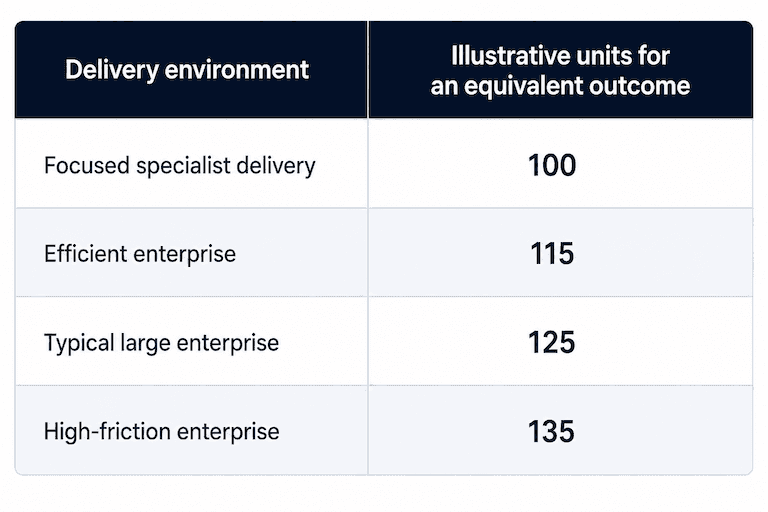
This illustration is intended to explain the principle, not to provide an industry benchmark or suggest that organisations fall neatly into these categories. Enterprises can operate highly efficient systems and smaller organisations can be chaotic. The relevant point is that delivery conditions alter how much effort the same outcome requires.
The mathematics behind that effect is important. If an environment is 20 per cent less productive, it does not require 20 per cent more effort to complete the same work. It requires 25 per cent more:

For an outcome requiring 100 aligned units at an 80 per cent productivity rate:
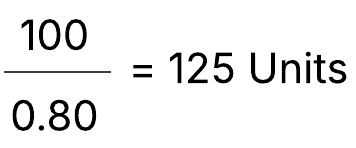
This is not a claim that every enterprise is automatically 20 per cent less productive. It shows why apparently modest losses become material across a multi-year programme involving hundreds of people and several suppliers.
Where do the additional units go?
Enterprise waste rarely appears as somebody doing an obviously pointless job. It accumulates between legitimate activities.
We have seen a low-risk change requiring minutes of engineering remain blocked for weeks because it required a committee decision. The implementation was almost costless. The surrounding queue consumed attention, blocked dependencies and deferred progress. The change takes five minutes. The organisation takes five weeks.
Other recurring sources of additional effort include:
- Decisions travelling through more people than their risk or consequence requires.
- Architecture, security and operational constraints arriving sequentially after work has begun.
- Governance functions unable to point to the documented policy, threshold or delegated authority behind a decision.
- Delivery teams waiting for access, environments, identity, infrastructure or other shared services.
- Evidence being rewritten for several assurance functions instead of reused.
- Customer and supplier governance models creating duplicated reporting and approvals.
- Requirements moving across business, product, architecture, engineering, test and operations without clear end-to-end ownership.
- Rework caused by late, fragmented or repeatedly reopened decisions.
McKinsey's research into organisational decision-making found that only 20 per cent of respondents believed their organisations excelled at decision-making, while 61 per cent said most decision-making time was used ineffectively. Its analysis associated faster, higher-quality decisions with fewer reporting layers and decisions made at the appropriate level.
DORA's 2024 research associated unstable organisational priorities with reduced productivity and increased burnout. PMI's 2026 Pulse of the Profession connects complexity with fragmented alignment, decision friction and rework.
The lesson is not that complexity can be removed. It is that complexity should not become an unpriced explanation for avoidable loss.
Delivery Unit Yield
Delivery yield is one way to think about how much of an organisation’s funded capacity advances the intended outcome or provides necessary and proportionate protection.
At a conceptual level, that effort might be classified across four broad categories:
- Productive units create, validate or advance the intended outcome.
- Protective units provide necessary and proportionate security, privacy, compliance, resilience and operational assurance.
- Coordination units connect the people, decisions and dependencies genuinely required for delivery.
- Recoverable units arise from avoidable waiting, duplication, unnecessary hand-offs and rework.
Expressed as a deliberately simplified relationship:

This is not intended to become an exhaustive accounting exercise. Attempting to classify every hour spent by every person would create its own administrative burden and a false impression of precision. The more useful application is to identify material constraints, such as delayed decisions, repeated assurance, unnecessary hand-offs or significant rework, and trace their consequences.
Delivery yield should not be treated as an employee productivity score or a universal programme target. People inside a low-yield system are often working extremely hard to compensate for it. Nor does the concept treat all governance as waste. Necessary protection contributes positively because a fast transformation that exposes customers, data or operations is not a successful outcome.
Effort, elapsed time and value are not interchangeable
The economic consequence becomes clearer when three perspectives are kept separate:
Effort is the human work consumed across employees, suppliers, governance and shared services.
Elapsed time is the calendar duration between starting work and achieving an accepted operational result.
Value is the commercial or strategic benefit that remains unrealised while the outcome waits.
A decision could consume two hours of direct effort and create three weeks of delay. Its immediate labour cost is small, but the blocked capacity, downstream rework and deferred value may be substantial.
Equally, recoverable effort does not automatically become a cash saving. It might become capacity redeployed to another priority, avoided future expenditure, more scope delivered within the same budget or value realised earlier. Credible financial analysis keeps those outcomes separate and makes attribution and uncertainty visible.
This is why a complaint about slow governance is not enough. Leadership needs to know what activity occurred, which outcome it affected, how much effort or delay it introduced and what economic consequence can reasonably be attributed to it.
That is the traceable connection.
Measurement does not change the system
Knowing where capacity goes is necessary, but it is not the outcome.
The practical response is pragmatism: matching the level of governance and scrutiny to the risk, reversibility and consequence of the decision.
High-risk decisions affecting regulated data, customers or critical operations deserve scrutiny and clear authority. A bounded, observable and readily reversible decision should not automatically travel through the same process.
A pragmatic approach also recognises that delay carries risk. Some decisions need to be made early because the programme becomes more expensive to change around them. Requirements must be clear enough to support investment, architecture and acceptance. Policies should define the safe space in which surrounding teams are authorised to operate, not merely catalogue what they cannot do.
Central technology and shared-service teams remain essential, but authority should be connected to accountability. A function controlling a gate should understand not only whether it completed its own process, but also the capacity blocked, rework created and value deferred by how that process operates.
The objective is not to remove governance. It is to make safe progress easier.
From programme activity to economic consequence
Spicy Mango combines strategic consulting, enterprise architecture and hands-on engineering to follow an outcome across the organisational boundaries where delivery effort is often lost.
We help organisations understand how a programme operates as a system, trace material constraints to their effects on effort, elapsed time and economic value, and improve decision routes, policies, requirements, supplier boundaries and technical foundations. Where intervention requires architecture or engineering, our senior practitioners can implement it rather than handing the conclusion to another organisation.
This is more than supplying additional capacity. It is the ability to understand and improve the system converting investment into progress.
Every programme activity has an economic consequence. Spicy Mango makes that connection traceable.
If transformation expenditure is rising without proportional progress, governance repeatedly blocks delivery, supplier responsibilities are fragmented or leadership is considering adding more capacity, the first question should not be how much more the programme needs - it should be how much yield the existing investment is producing.
Why does everything around the work cost more than the work itself?
Every programme activity has an economic consequence. The problem is that most organisations cannot trace the connection. They can see the programme budget, they know how many people and suppliers are involved, they receive progress reports, risk registers and delivery forecasts. What remains much harder to see is how effectively that investment is being converted into an accepted business outcome.
A team may be fully occupied without making proportional progress. A governance decision may require only an hour of direct work yet leave several teams waiting for weeks. A supplier may appear efficient while transferring coordination and integration effort back into the customer. Every local process can operate as designed while the complete programme becomes slower and more expensive.
That is the hidden economics of transformation.
At Spicy Mango, we believe in the need for a traceable connection from programme activity to economic consequence. Not a broad assertion that bureaucracy is expensive, but evidence that demonstrates where funded effort is being consumed, how that affects elapsed time and what it means for cost and business value.
The same outcome does not cost every organisation the same
Large enterprises do not move slowly because their people are less capable, but because delivery passes through more organisational machinery.
Architecture, security, privacy, procurement, legal, finance, operations, shared services and business stakeholders may all have legitimate responsibilities. Large organisations carry customer, regulatory, operational and reputational exposures that smaller companies may not. Appropriate controls are part of a successful outcome. But necessary machinery still consumes capacity.
Every approval needs evidence. Every stakeholder needs context. Every organisational boundary creates a hand-off. Every central dependency introduces a queue that the programme may not control. When a constraint arrives late, work may have to be redesigned, retested and reassured.
The enterprise therefore pays for the solution and for the environment through which the solution must travel.
A neutral unit of delivery effort
One way we think about this at Spicy Mango is through the concept of a delivery unit.
One unit is a neutral measure of human effort. It could represent an hour, person-day or person-month, depending on the programme. It is not a price, job title or universal productivity benchmark. Its purpose is to create a common basis for examining the effort required to reach an equivalent outcome.
As a simple illustration, if a focused specialist requires 100 units to deliver a defined outcome, different delivery conditions might increase the effort required:
This illustration is intended to explain the principle, not to provide an industry benchmark or suggest that organisations fall neatly into these categories. Enterprises can operate highly efficient systems and smaller organisations can be chaotic. The relevant point is that delivery conditions alter how much effort the same outcome requires.
The mathematics behind that effect is important. If an environment is 20 per cent less productive, it does not require 20 per cent more effort to complete the same work. It requires 25 per cent more:
For an outcome requiring 100 aligned units at an 80 per cent productivity rate:
This is not a claim that every enterprise is automatically 20 per cent less productive. It shows why apparently modest losses become material across a multi-year programme involving hundreds of people and several suppliers.
Where do the additional units go?
Enterprise waste rarely appears as somebody doing an obviously pointless job. It accumulates between legitimate activities.
We have seen a low-risk change requiring minutes of engineering remain blocked for weeks because it required a committee decision. The implementation was almost costless. The surrounding queue consumed attention, blocked dependencies and deferred progress. The change takes five minutes. The organisation takes five weeks.
Other recurring sources of additional effort include:
- Decisions travelling through more people than their risk or consequence requires.
- Architecture, security and operational constraints arriving sequentially after work has begun.
- Governance functions unable to point to the documented policy, threshold or delegated authority behind a decision.
- Delivery teams waiting for access, environments, identity, infrastructure or other shared services.
- Evidence being rewritten for several assurance functions instead of reused.
- Customer and supplier governance models creating duplicated reporting and approvals.
- Requirements moving across business, product, architecture, engineering, test and operations without clear end-to-end ownership.
- Rework caused by late, fragmented or repeatedly reopened decisions.
McKinsey's research into organisational decision-making found that only 20 per cent of respondents believed their organisations excelled at decision-making, while 61 per cent said most decision-making time was used ineffectively. Its analysis associated faster, higher-quality decisions with fewer reporting layers and decisions made at the appropriate level.
DORA's 2024 research associated unstable organisational priorities with reduced productivity and increased burnout. PMI's 2026 Pulse of the Profession connects complexity with fragmented alignment, decision friction and rework.
The lesson is not that complexity can be removed. It is that complexity should not become an unpriced explanation for avoidable loss.
Delivery Unit Yield
Delivery yield is one way to think about how much of an organisation’s funded capacity advances the intended outcome or provides necessary and proportionate protection.
At a conceptual level, that effort might be classified across four broad categories:
- Productive units create, validate or advance the intended outcome.
- Protective units provide necessary and proportionate security, privacy, compliance, resilience and operational assurance.
- Coordination units connect the people, decisions and dependencies genuinely required for delivery.
- Recoverable units arise from avoidable waiting, duplication, unnecessary hand-offs and rework.
Expressed as a deliberately simplified relationship:
This is not intended to become an exhaustive accounting exercise. Attempting to classify every hour spent by every person would create its own administrative burden and a false impression of precision. The more useful application is to identify material constraints, such as delayed decisions, repeated assurance, unnecessary hand-offs or significant rework, and trace their consequences.
Delivery yield should not be treated as an employee productivity score or a universal programme target. People inside a low-yield system are often working extremely hard to compensate for it. Nor does the concept treat all governance as waste. Necessary protection contributes positively because a fast transformation that exposes customers, data or operations is not a successful outcome.
Effort, elapsed time and value are not interchangeable
The economic consequence becomes clearer when three perspectives are kept separate:
Effort is the human work consumed across employees, suppliers, governance and shared services.
Elapsed time is the calendar duration between starting work and achieving an accepted operational result.
Value is the commercial or strategic benefit that remains unrealised while the outcome waits.
A decision could consume two hours of direct effort and create three weeks of delay. Its immediate labour cost is small, but the blocked capacity, downstream rework and deferred value may be substantial.
Equally, recoverable effort does not automatically become a cash saving. It might become capacity redeployed to another priority, avoided future expenditure, more scope delivered within the same budget or value realised earlier. Credible financial analysis keeps those outcomes separate and makes attribution and uncertainty visible.
This is why a complaint about slow governance is not enough. Leadership needs to know what activity occurred, which outcome it affected, how much effort or delay it introduced and what economic consequence can reasonably be attributed to it.
That is the traceable connection.
Measurement does not change the system
Knowing where capacity goes is necessary, but it is not the outcome.
The practical response is pragmatism: matching the level of governance and scrutiny to the risk, reversibility and consequence of the decision.
High-risk decisions affecting regulated data, customers or critical operations deserve scrutiny and clear authority. A bounded, observable and readily reversible decision should not automatically travel through the same process.
A pragmatic approach also recognises that delay carries risk. Some decisions need to be made early because the programme becomes more expensive to change around them. Requirements must be clear enough to support investment, architecture and acceptance. Policies should define the safe space in which surrounding teams are authorised to operate, not merely catalogue what they cannot do.
Central technology and shared-service teams remain essential, but authority should be connected to accountability. A function controlling a gate should understand not only whether it completed its own process, but also the capacity blocked, rework created and value deferred by how that process operates.
The objective is not to remove governance. It is to make safe progress easier.
From programme activity to economic consequence
Spicy Mango combines strategic consulting, enterprise architecture and hands-on engineering to follow an outcome across the organisational boundaries where delivery effort is often lost.
We help organisations understand how a programme operates as a system, trace material constraints to their effects on effort, elapsed time and economic value, and improve decision routes, policies, requirements, supplier boundaries and technical foundations. Where intervention requires architecture or engineering, our senior practitioners can implement it rather than handing the conclusion to another organisation.
This is more than supplying additional capacity. It is the ability to understand and improve the system converting investment into progress.
Every programme activity has an economic consequence. Spicy Mango makes that connection traceable.
If transformation expenditure is rising without proportional progress, governance repeatedly blocks delivery, supplier responsibilities are fragmented or leadership is considering adding more capacity, the first question should not be how much more the programme needs - it should be how much yield the existing investment is producing.
Why does everything around the work cost more than the work itself?
Every programme activity has an economic consequence. The problem is that most organisations cannot trace the connection. They can see the programme budget, they know how many people and suppliers are involved, they receive progress reports, risk registers and delivery forecasts. What remains much harder to see is how effectively that investment is being converted into an accepted business outcome.
A team may be fully occupied without making proportional progress. A governance decision may require only an hour of direct work yet leave several teams waiting for weeks. A supplier may appear efficient while transferring coordination and integration effort back into the customer. Every local process can operate as designed while the complete programme becomes slower and more expensive.
That is the hidden economics of transformation.
At Spicy Mango, we believe in the need for a traceable connection from programme activity to economic consequence. Not a broad assertion that bureaucracy is expensive, but evidence that demonstrates where funded effort is being consumed, how that affects elapsed time and what it means for cost and business value.
The same outcome does not cost every organisation the same
Large enterprises do not move slowly because their people are less capable, but because delivery passes through more organisational machinery.
Architecture, security, privacy, procurement, legal, finance, operations, shared services and business stakeholders may all have legitimate responsibilities. Large organisations carry customer, regulatory, operational and reputational exposures that smaller companies may not. Appropriate controls are part of a successful outcome. But necessary machinery still consumes capacity.
Every approval needs evidence. Every stakeholder needs context. Every organisational boundary creates a hand-off. Every central dependency introduces a queue that the programme may not control. When a constraint arrives late, work may have to be redesigned, retested and reassured.
The enterprise therefore pays for the solution and for the environment through which the solution must travel.
A neutral unit of delivery effort
One way we think about this at Spicy Mango is through the concept of a delivery unit.
One unit is a neutral measure of human effort. It could represent an hour, person-day or person-month, depending on the programme. It is not a price, job title or universal productivity benchmark. Its purpose is to create a common basis for examining the effort required to reach an equivalent outcome.
As a simple illustration, if a focused specialist requires 100 units to deliver a defined outcome, different delivery conditions might increase the effort required:
This illustration is intended to explain the principle, not to provide an industry benchmark or suggest that organisations fall neatly into these categories. Enterprises can operate highly efficient systems and smaller organisations can be chaotic. The relevant point is that delivery conditions alter how much effort the same outcome requires.
The mathematics behind that effect is important. If an environment is 20 per cent less productive, it does not require 20 per cent more effort to complete the same work. It requires 25 per cent more:
For an outcome requiring 100 aligned units at an 80 per cent productivity rate:
This is not a claim that every enterprise is automatically 20 per cent less productive. It shows why apparently modest losses become material across a multi-year programme involving hundreds of people and several suppliers.
Where do the additional units go?
Enterprise waste rarely appears as somebody doing an obviously pointless job. It accumulates between legitimate activities.
We have seen a low-risk change requiring minutes of engineering remain blocked for weeks because it required a committee decision. The implementation was almost costless. The surrounding queue consumed attention, blocked dependencies and deferred progress. The change takes five minutes. The organisation takes five weeks.
Other recurring sources of additional effort include:
- Decisions travelling through more people than their risk or consequence requires.
- Architecture, security and operational constraints arriving sequentially after work has begun.
- Governance functions unable to point to the documented policy, threshold or delegated authority behind a decision.
- Delivery teams waiting for access, environments, identity, infrastructure or other shared services.
- Evidence being rewritten for several assurance functions instead of reused.
- Customer and supplier governance models creating duplicated reporting and approvals.
- Requirements moving across business, product, architecture, engineering, test and operations without clear end-to-end ownership.
- Rework caused by late, fragmented or repeatedly reopened decisions.
McKinsey's research into organisational decision-making found that only 20 per cent of respondents believed their organisations excelled at decision-making, while 61 per cent said most decision-making time was used ineffectively. Its analysis associated faster, higher-quality decisions with fewer reporting layers and decisions made at the appropriate level.
DORA's 2024 research associated unstable organisational priorities with reduced productivity and increased burnout. PMI's 2026 Pulse of the Profession connects complexity with fragmented alignment, decision friction and rework.
The lesson is not that complexity can be removed. It is that complexity should not become an unpriced explanation for avoidable loss.
Delivery Unit Yield
Delivery yield is one way to think about how much of an organisation’s funded capacity advances the intended outcome or provides necessary and proportionate protection.
At a conceptual level, that effort might be classified across four broad categories:
- Productive units create, validate or advance the intended outcome.
- Protective units provide necessary and proportionate security, privacy, compliance, resilience and operational assurance.
- Coordination units connect the people, decisions and dependencies genuinely required for delivery.
- Recoverable units arise from avoidable waiting, duplication, unnecessary hand-offs and rework.
Expressed as a deliberately simplified relationship:
This is not intended to become an exhaustive accounting exercise. Attempting to classify every hour spent by every person would create its own administrative burden and a false impression of precision. The more useful application is to identify material constraints, such as delayed decisions, repeated assurance, unnecessary hand-offs or significant rework, and trace their consequences.
Delivery yield should not be treated as an employee productivity score or a universal programme target. People inside a low-yield system are often working extremely hard to compensate for it. Nor does the concept treat all governance as waste. Necessary protection contributes positively because a fast transformation that exposes customers, data or operations is not a successful outcome.
Effort, elapsed time and value are not interchangeable
The economic consequence becomes clearer when three perspectives are kept separate:
Effort is the human work consumed across employees, suppliers, governance and shared services.
Elapsed time is the calendar duration between starting work and achieving an accepted operational result.
Value is the commercial or strategic benefit that remains unrealised while the outcome waits.
A decision could consume two hours of direct effort and create three weeks of delay. Its immediate labour cost is small, but the blocked capacity, downstream rework and deferred value may be substantial.
Equally, recoverable effort does not automatically become a cash saving. It might become capacity redeployed to another priority, avoided future expenditure, more scope delivered within the same budget or value realised earlier. Credible financial analysis keeps those outcomes separate and makes attribution and uncertainty visible.
This is why a complaint about slow governance is not enough. Leadership needs to know what activity occurred, which outcome it affected, how much effort or delay it introduced and what economic consequence can reasonably be attributed to it.
That is the traceable connection.
Measurement does not change the system
Knowing where capacity goes is necessary, but it is not the outcome.
The practical response is pragmatism: matching the level of governance and scrutiny to the risk, reversibility and consequence of the decision.
High-risk decisions affecting regulated data, customers or critical operations deserve scrutiny and clear authority. A bounded, observable and readily reversible decision should not automatically travel through the same process.
A pragmatic approach also recognises that delay carries risk. Some decisions need to be made early because the programme becomes more expensive to change around them. Requirements must be clear enough to support investment, architecture and acceptance. Policies should define the safe space in which surrounding teams are authorised to operate, not merely catalogue what they cannot do.
Central technology and shared-service teams remain essential, but authority should be connected to accountability. A function controlling a gate should understand not only whether it completed its own process, but also the capacity blocked, rework created and value deferred by how that process operates.
The objective is not to remove governance. It is to make safe progress easier.
From programme activity to economic consequence
Spicy Mango combines strategic consulting, enterprise architecture and hands-on engineering to follow an outcome across the organisational boundaries where delivery effort is often lost.
We help organisations understand how a programme operates as a system, trace material constraints to their effects on effort, elapsed time and economic value, and improve decision routes, policies, requirements, supplier boundaries and technical foundations. Where intervention requires architecture or engineering, our senior practitioners can implement it rather than handing the conclusion to another organisation.
This is more than supplying additional capacity. It is the ability to understand and improve the system converting investment into progress.
Every programme activity has an economic consequence. Spicy Mango makes that connection traceable.
If transformation expenditure is rising without proportional progress, governance repeatedly blocks delivery, supplier responsibilities are fragmented or leadership is considering adding more capacity, the first question should not be how much more the programme needs - it should be how much yield the existing investment is producing.
Why does everything around the work cost more than the work itself?
Every programme activity has an economic consequence. The problem is that most organisations cannot trace the connection. They can see the programme budget, they know how many people and suppliers are involved, they receive progress reports, risk registers and delivery forecasts. What remains much harder to see is how effectively that investment is being converted into an accepted business outcome.
A team may be fully occupied without making proportional progress. A governance decision may require only an hour of direct work yet leave several teams waiting for weeks. A supplier may appear efficient while transferring coordination and integration effort back into the customer. Every local process can operate as designed while the complete programme becomes slower and more expensive.
That is the hidden economics of transformation.
At Spicy Mango, we believe in the need for a traceable connection from programme activity to economic consequence. Not a broad assertion that bureaucracy is expensive, but evidence that demonstrates where funded effort is being consumed, how that affects elapsed time and what it means for cost and business value.
The same outcome does not cost every organisation the same
Large enterprises do not move slowly because their people are less capable, but because delivery passes through more organisational machinery.
Architecture, security, privacy, procurement, legal, finance, operations, shared services and business stakeholders may all have legitimate responsibilities. Large organisations carry customer, regulatory, operational and reputational exposures that smaller companies may not. Appropriate controls are part of a successful outcome. But necessary machinery still consumes capacity.
Every approval needs evidence. Every stakeholder needs context. Every organisational boundary creates a hand-off. Every central dependency introduces a queue that the programme may not control. When a constraint arrives late, work may have to be redesigned, retested and reassured.
The enterprise therefore pays for the solution and for the environment through which the solution must travel.
A neutral unit of delivery effort
One way we think about this at Spicy Mango is through the concept of a delivery unit.
One unit is a neutral measure of human effort. It could represent an hour, person-day or person-month, depending on the programme. It is not a price, job title or universal productivity benchmark. Its purpose is to create a common basis for examining the effort required to reach an equivalent outcome.
As a simple illustration, if a focused specialist requires 100 units to deliver a defined outcome, different delivery conditions might increase the effort required:
This illustration is intended to explain the principle, not to provide an industry benchmark or suggest that organisations fall neatly into these categories. Enterprises can operate highly efficient systems and smaller organisations can be chaotic. The relevant point is that delivery conditions alter how much effort the same outcome requires.
The mathematics behind that effect is important. If an environment is 20 per cent less productive, it does not require 20 per cent more effort to complete the same work. It requires 25 per cent more:
For an outcome requiring 100 aligned units at an 80 per cent productivity rate:
This is not a claim that every enterprise is automatically 20 per cent less productive. It shows why apparently modest losses become material across a multi-year programme involving hundreds of people and several suppliers.
Where do the additional units go?
Enterprise waste rarely appears as somebody doing an obviously pointless job. It accumulates between legitimate activities.
We have seen a low-risk change requiring minutes of engineering remain blocked for weeks because it required a committee decision. The implementation was almost costless. The surrounding queue consumed attention, blocked dependencies and deferred progress. The change takes five minutes. The organisation takes five weeks.
Other recurring sources of additional effort include:
- Decisions travelling through more people than their risk or consequence requires.
- Architecture, security and operational constraints arriving sequentially after work has begun.
- Governance functions unable to point to the documented policy, threshold or delegated authority behind a decision.
- Delivery teams waiting for access, environments, identity, infrastructure or other shared services.
- Evidence being rewritten for several assurance functions instead of reused.
- Customer and supplier governance models creating duplicated reporting and approvals.
- Requirements moving across business, product, architecture, engineering, test and operations without clear end-to-end ownership.
- Rework caused by late, fragmented or repeatedly reopened decisions.
McKinsey's research into organisational decision-making found that only 20 per cent of respondents believed their organisations excelled at decision-making, while 61 per cent said most decision-making time was used ineffectively. Its analysis associated faster, higher-quality decisions with fewer reporting layers and decisions made at the appropriate level.
DORA's 2024 research associated unstable organisational priorities with reduced productivity and increased burnout. PMI's 2026 Pulse of the Profession connects complexity with fragmented alignment, decision friction and rework.
The lesson is not that complexity can be removed. It is that complexity should not become an unpriced explanation for avoidable loss.
Delivery Unit Yield
Delivery yield is one way to think about how much of an organisation’s funded capacity advances the intended outcome or provides necessary and proportionate protection.
At a conceptual level, that effort might be classified across four broad categories:
- Productive units create, validate or advance the intended outcome.
- Protective units provide necessary and proportionate security, privacy, compliance, resilience and operational assurance.
- Coordination units connect the people, decisions and dependencies genuinely required for delivery.
- Recoverable units arise from avoidable waiting, duplication, unnecessary hand-offs and rework.
Expressed as a deliberately simplified relationship:
This is not intended to become an exhaustive accounting exercise. Attempting to classify every hour spent by every person would create its own administrative burden and a false impression of precision. The more useful application is to identify material constraints, such as delayed decisions, repeated assurance, unnecessary hand-offs or significant rework, and trace their consequences.
Delivery yield should not be treated as an employee productivity score or a universal programme target. People inside a low-yield system are often working extremely hard to compensate for it. Nor does the concept treat all governance as waste. Necessary protection contributes positively because a fast transformation that exposes customers, data or operations is not a successful outcome.
Effort, elapsed time and value are not interchangeable
The economic consequence becomes clearer when three perspectives are kept separate:
Effort is the human work consumed across employees, suppliers, governance and shared services.
Elapsed time is the calendar duration between starting work and achieving an accepted operational result.
Value is the commercial or strategic benefit that remains unrealised while the outcome waits.
A decision could consume two hours of direct effort and create three weeks of delay. Its immediate labour cost is small, but the blocked capacity, downstream rework and deferred value may be substantial.
Equally, recoverable effort does not automatically become a cash saving. It might become capacity redeployed to another priority, avoided future expenditure, more scope delivered within the same budget or value realised earlier. Credible financial analysis keeps those outcomes separate and makes attribution and uncertainty visible.
This is why a complaint about slow governance is not enough. Leadership needs to know what activity occurred, which outcome it affected, how much effort or delay it introduced and what economic consequence can reasonably be attributed to it.
That is the traceable connection.
Measurement does not change the system
Knowing where capacity goes is necessary, but it is not the outcome.
The practical response is pragmatism: matching the level of governance and scrutiny to the risk, reversibility and consequence of the decision.
High-risk decisions affecting regulated data, customers or critical operations deserve scrutiny and clear authority. A bounded, observable and readily reversible decision should not automatically travel through the same process.
A pragmatic approach also recognises that delay carries risk. Some decisions need to be made early because the programme becomes more expensive to change around them. Requirements must be clear enough to support investment, architecture and acceptance. Policies should define the safe space in which surrounding teams are authorised to operate, not merely catalogue what they cannot do.
Central technology and shared-service teams remain essential, but authority should be connected to accountability. A function controlling a gate should understand not only whether it completed its own process, but also the capacity blocked, rework created and value deferred by how that process operates.
The objective is not to remove governance. It is to make safe progress easier.
From programme activity to economic consequence
Spicy Mango combines strategic consulting, enterprise architecture and hands-on engineering to follow an outcome across the organisational boundaries where delivery effort is often lost.
We help organisations understand how a programme operates as a system, trace material constraints to their effects on effort, elapsed time and economic value, and improve decision routes, policies, requirements, supplier boundaries and technical foundations. Where intervention requires architecture or engineering, our senior practitioners can implement it rather than handing the conclusion to another organisation.
This is more than supplying additional capacity. It is the ability to understand and improve the system converting investment into progress.
Every programme activity has an economic consequence. Spicy Mango makes that connection traceable.
If transformation expenditure is rising without proportional progress, governance repeatedly blocks delivery, supplier responsibilities are fragmented or leadership is considering adding more capacity, the first question should not be how much more the programme needs - it should be how much yield the existing investment is producing.
To find out more about anything you've read here, or to learn how Spicy Mango could help, drop us a note at hello@spicymango.co.uk, give us a call, or send us a message using our contact form and we'll be in touch.
To find out more about anything you've read here, or to learn how Spicy Mango could help, drop us a note at hello@spicymango.co.uk, give us a call, or send us a message using our contact form and we'll be in touch.
To find out more about anything you've read here, or to learn how Spicy Mango could help, drop us a note at hello@spicymango.co.uk, give us a call, or send us a message using our contact form and we'll be in touch.