

SGAI in Sports Advertising: Using RTB and Structured Sports Data to Drive Emotive Engagement
Live sport delivers some of the highest audience engagement in streaming. But for operators and streaming providers, it also presents a persistent challenge: advertising within live sports streams is often traded with surprisingly little understanding of what is actually happening on screen.
Server Guided Ad Insertion (SGAI) is changing that. By combining SGAI with OpenRTB and structured sports data, platforms can move beyond generic sports inventory towards advertising that responds to the context and emotion of the game itself. The result is not just improved monetisation, but higher ad engagement and more sustainable inventory value.
This article explores how RTB and SGAI work together in sports advertising, and why structured sports data is essential to unlocking their full potential.
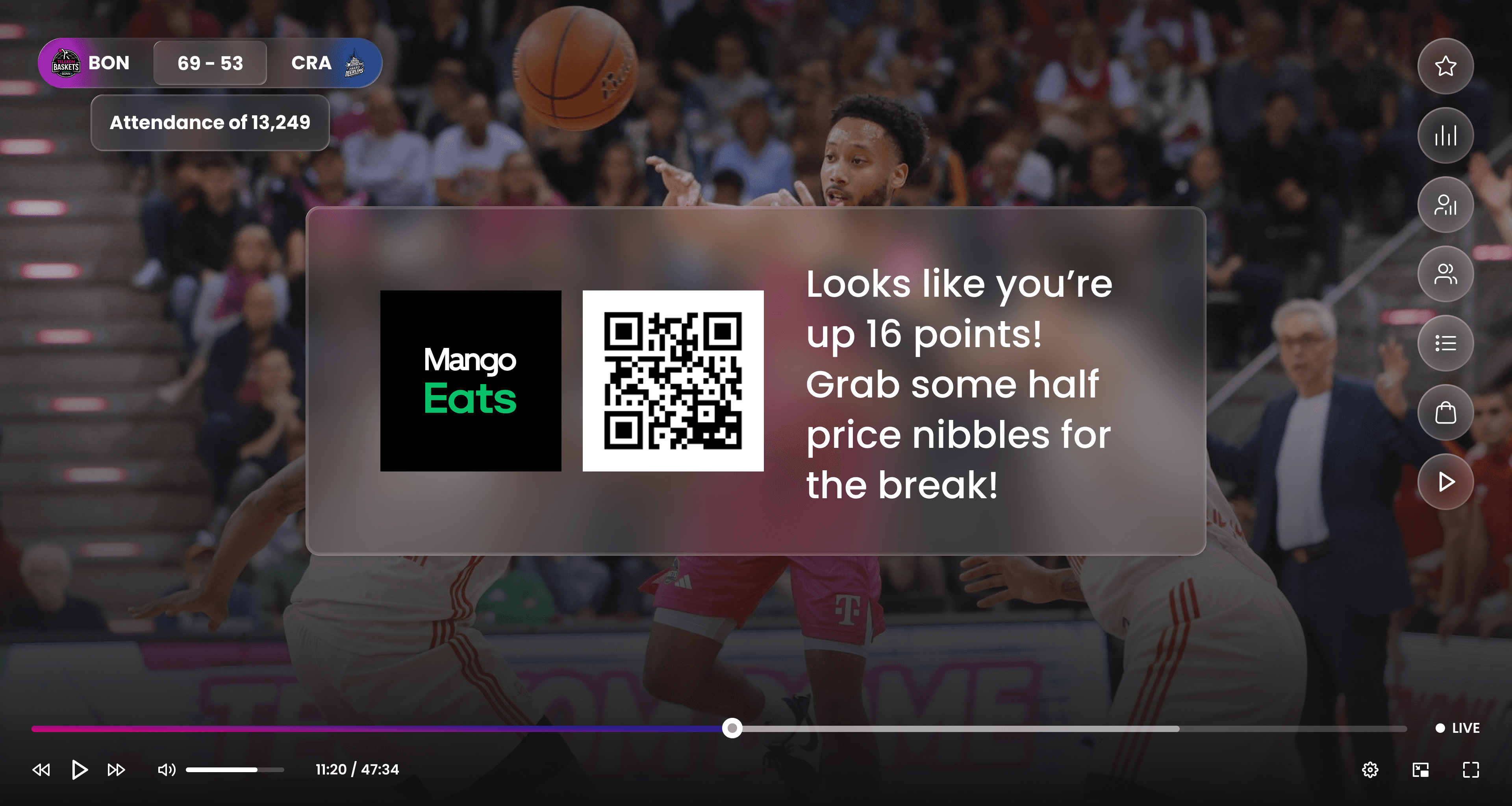
The Operator Challenge: Engagement Without Increasing Ad Load
Streaming providers are under constant pressure to increase advertising performance while protecting the viewing experience. In live sport, the pressure's amplified. Fans are highly engaged, but also highly sensitive to disruption.
Traditional server-side ad insertion treats live sport as a uniform stream, with ad opportunities triggered by timing rather than context. From an advertising perspective, a break before kick-off is valued in much the same way as a break after a decisive goal.
SGAI introduces a more sophisticated model. By guiding ad requests using real-time signals from the content, SGAI allows platforms to differentiate between moments, and to expose higher-value opportunities to the market when viewer attention is at its peak.
Why Emotion Matters in SGAI for Sports Advertising
Sport is inherently emotional. Tension builds, momentum shifts, and key moments can transform viewer attention in seconds. Advertising that aligns with these emotional peaks consistently performs better.
Industry research shows that emotion-targeted contextual campaigns deliver a 33% lift in brand awareness and a 15% lift in purchase intent. For operators and streaming providers, this insight is critical.
Emotionally aligned advertising doesn't just benefit advertisers. It also:
Increases viewer attention and recall
Reduces perceived disruption during ad breaks
Supports stronger demand and pricing confidence over time
SGAI provides the mechanism to act on this insight - but only if the emotional context of the game can be communicated into the real-time bidding process.

RTB and SGAI: Establishing Context Through OpenRTB
At the heart of most SGAI implementations is OpenRTB. The OpenRTB bid request is how ad opportunities are described and evaluated in real time, making it the critical interface between live sports content and programmatic decisioning.
The OpenRTB content Object
Within an SGAI workflow, the content object establishes the editorial and broadcast context of the stream. For sports, this typically includes:
content.title
e.g. “FIFA Club World Cup: England vs Amsterdam”content.series/content.season
Identifying the tournament or competition phasecontent.genre/content.cat
Sports categorisationcontent.producer
Rights holder or broadcastercontent.context
Commonly live, video or user-generatedcontent.live0(not live),1(live),2(upcoming)content.len
Stream window or segment durationcontent.channel
Channel or service identifier
These fields allow buyers to understand what they are bidding on and where the ad will appear. They are essential, but they still describe the match as a single asset rather than a sequence of moments.
Using RTB for Sports in SGAI: Capturing the Moment
To unlock the real value of SGAI in sports advertising, platforms must describe not just the event, but the state of play. This is achieved through the OpenRTB ext object, which allows richer domain-specific data to be passed into the bid request.
Sports-Specific Signals in the ext Object
For live sport, ext fields can include:
Current game state
Minute of play, period, half-time or overtimeScoreline
Current score and competitive balanceCompetition name and team IDs
Passed as standardised identifiersEvent signals
Such as goal scored, penalty awarded or red cardEmotional context
Indicators of heightened tension, celebration or drama
These signals transform the bid request into a real-time snapshot of the match. For DSPs, this enables bidding and creative decisions that align with both context and emotion, a proven driver of ad engagement.
The Role of Structured Sports Data in RTB and SGAI
The effectiveness of RTB in an SGAI environment depends entirely on data quality. Live sports data is fast-moving, multi-sourced and often inconsistent. Without standardisation, contextual and emotional signals quickly lose reliability.
A sports data platform such as Gameday provides the necessary abstraction layer by:
Normalising teams, competitions and identifiers
Standardising match states and event definitions
Generating reliable emotional context signals
Producing outputs suitable for direct inclusion in OpenRTB payloads
This standardisation is critical for scale. It allows operators to support emotion-aware advertising strategies across sports, competitions and regions without bespoke integrations for each event.
Teaching the Bid Request to Understand Sport
When structured sports data flows into OpenRTB content and ext objects, the bid request itself becomes an intelligence layer. It teaches the advertising ecosystem to recognise the difference between routine play and high-impact moments.
Consider a live football final entering the last ten minutes with the score level. Gameday standardises the match state and scoreline, flags a high-tension emotional context, and feeds this into the OpenRTB ext object. An SGAI-enabled platform exposes this opportunity to the market, allowing buyers to respond with bids and creative aligned to the intensity of the moment.
This approach increases engagement without increasing ad load, a critical objective for streaming providers.
SGAI in Sports Advertising: A Strategic Shift
SGAI is often discussed in terms of operational efficiency and yield management. In sports advertising, its real impact is strategic. By combining SGAI with RTB and structured sports data, operators can align advertising with how fans actually experience live sport.
Emotion becomes measurable. Context becomes actionable. Advertising becomes more relevant.
As live sport continues to anchor the value of streaming platforms, the question is no longer whether RTB and SGAI should account for emotional context, but whether platforms are structurally equipped to support it.
For operators looking to increase ad engagement in live sports, this represents not an incremental improvement, but a fundamental evolution in how sports advertising is delivered.
Structured Sports Data as the Foundation for SGAI
For SGAI and RTB to work effectively in live sports environments, structured data is not optional, it's foundational. Real-time bidding systems can only act on the signals they receive, and in sport those signals must be accurate, timely and consistently defined if they are to support meaningful decisioning.
Gameday is Spicy Mango’s structured sports data platform designed to address this challenge. It ingests live sports data from multiple sources, standardises competitions, teams, match states and events, and produces structured and consistent outputs that can be embedded directly into OpenRTB bid requests. By providing a consistent representation of what is happening in the game - including moment-level and emotional context, Gameday enables SGAI architectures to expose richer, more actionable signals to programmatic markets.
In this way, Gameday acts as the connective layer between live sports production and advertising decisioning, helping operators and streaming providers turn live moments into context-aware ad opportunities without increasing complexity at the delivery layer.
Learn more about how Gameday structures and standardises sports data for use in streaming and advertising workflows here.
SGAI in Sports Advertising: Using RTB and Structured Sports Data to Drive Emotive Engagement
Live sport delivers some of the highest audience engagement in streaming. But for operators and streaming providers, it also presents a persistent challenge: advertising within live sports streams is often traded with surprisingly little understanding of what is actually happening on screen.
Server Guided Ad Insertion (SGAI) is changing that. By combining SGAI with OpenRTB and structured sports data, platforms can move beyond generic sports inventory towards advertising that responds to the context and emotion of the game itself. The result is not just improved monetisation, but higher ad engagement and more sustainable inventory value.
This article explores how RTB and SGAI work together in sports advertising, and why structured sports data is essential to unlocking their full potential.
The Operator Challenge: Engagement Without Increasing Ad Load
Streaming providers are under constant pressure to increase advertising performance while protecting the viewing experience. In live sport, the pressure's amplified. Fans are highly engaged, but also highly sensitive to disruption.
Traditional server-side ad insertion treats live sport as a uniform stream, with ad opportunities triggered by timing rather than context. From an advertising perspective, a break before kick-off is valued in much the same way as a break after a decisive goal.
SGAI introduces a more sophisticated model. By guiding ad requests using real-time signals from the content, SGAI allows platforms to differentiate between moments, and to expose higher-value opportunities to the market when viewer attention is at its peak.
Why Emotion Matters in SGAI for Sports Advertising
Sport is inherently emotional. Tension builds, momentum shifts, and key moments can transform viewer attention in seconds. Advertising that aligns with these emotional peaks consistently performs better.
Industry research shows that emotion-targeted contextual campaigns deliver a 33% lift in brand awareness and a 15% lift in purchase intent. For operators and streaming providers, this insight is critical.
Emotionally aligned advertising doesn't just benefit advertisers. It also:
Increases viewer attention and recall
Reduces perceived disruption during ad breaks
Supports stronger demand and pricing confidence over time
SGAI provides the mechanism to act on this insight - but only if the emotional context of the game can be communicated into the real-time bidding process.
RTB and SGAI: Establishing Context Through OpenRTB
At the heart of most SGAI implementations is OpenRTB. The OpenRTB bid request is how ad opportunities are described and evaluated in real time, making it the critical interface between live sports content and programmatic decisioning.
The OpenRTB content Object
Within an SGAI workflow, the content object establishes the editorial and broadcast context of the stream. For sports, this typically includes:
content.title
e.g. “FIFA Club World Cup: England vs Amsterdam”content.series/content.season
Identifying the tournament or competition phasecontent.genre/content.cat
Sports categorisationcontent.producer
Rights holder or broadcastercontent.context
Commonly live, video or user-generatedcontent.live0(not live),1(live),2(upcoming)content.len
Stream window or segment durationcontent.channel
Channel or service identifier
These fields allow buyers to understand what they are bidding on and where the ad will appear. They are essential, but they still describe the match as a single asset rather than a sequence of moments.
Using RTB for Sports in SGAI: Capturing the Moment
To unlock the real value of SGAI in sports advertising, platforms must describe not just the event, but the state of play. This is achieved through the OpenRTB ext object, which allows richer domain-specific data to be passed into the bid request.
Sports-Specific Signals in the ext Object
For live sport, ext fields can include:
Current game state
Minute of play, period, half-time or overtimeScoreline
Current score and competitive balanceCompetition name and team IDs
Passed as standardised identifiersEvent signals
Such as goal scored, penalty awarded or red cardEmotional context
Indicators of heightened tension, celebration or drama
These signals transform the bid request into a real-time snapshot of the match. For DSPs, this enables bidding and creative decisions that align with both context and emotion, a proven driver of ad engagement.
The Role of Structured Sports Data in RTB and SGAI
The effectiveness of RTB in an SGAI environment depends entirely on data quality. Live sports data is fast-moving, multi-sourced and often inconsistent. Without standardisation, contextual and emotional signals quickly lose reliability.
A sports data platform such as Gameday provides the necessary abstraction layer by:
Normalising teams, competitions and identifiers
Standardising match states and event definitions
Generating reliable emotional context signals
Producing outputs suitable for direct inclusion in OpenRTB payloads
This standardisation is critical for scale. It allows operators to support emotion-aware advertising strategies across sports, competitions and regions without bespoke integrations for each event.
Teaching the Bid Request to Understand Sport
When structured sports data flows into OpenRTB content and ext objects, the bid request itself becomes an intelligence layer. It teaches the advertising ecosystem to recognise the difference between routine play and high-impact moments.
Consider a live football final entering the last ten minutes with the score level. Gameday standardises the match state and scoreline, flags a high-tension emotional context, and feeds this into the OpenRTB ext object. An SGAI-enabled platform exposes this opportunity to the market, allowing buyers to respond with bids and creative aligned to the intensity of the moment.
This approach increases engagement without increasing ad load, a critical objective for streaming providers.
SGAI in Sports Advertising: A Strategic Shift
SGAI is often discussed in terms of operational efficiency and yield management. In sports advertising, its real impact is strategic. By combining SGAI with RTB and structured sports data, operators can align advertising with how fans actually experience live sport.
Emotion becomes measurable. Context becomes actionable. Advertising becomes more relevant.
As live sport continues to anchor the value of streaming platforms, the question is no longer whether RTB and SGAI should account for emotional context, but whether platforms are structurally equipped to support it.
For operators looking to increase ad engagement in live sports, this represents not an incremental improvement, but a fundamental evolution in how sports advertising is delivered.
Structured Sports Data as the Foundation for SGAI
For SGAI and RTB to work effectively in live sports environments, structured data is not optional, it's foundational. Real-time bidding systems can only act on the signals they receive, and in sport those signals must be accurate, timely and consistently defined if they are to support meaningful decisioning.
Gameday is Spicy Mango’s structured sports data platform designed to address this challenge. It ingests live sports data from multiple sources, standardises competitions, teams, match states and events, and produces structured and consistent outputs that can be embedded directly into OpenRTB bid requests. By providing a consistent representation of what is happening in the game - including moment-level and emotional context, Gameday enables SGAI architectures to expose richer, more actionable signals to programmatic markets.
In this way, Gameday acts as the connective layer between live sports production and advertising decisioning, helping operators and streaming providers turn live moments into context-aware ad opportunities without increasing complexity at the delivery layer.
Learn more about how Gameday structures and standardises sports data for use in streaming and advertising workflows here.
SGAI in Sports Advertising: Using RTB and Structured Sports Data to Drive Emotive Engagement
Live sport delivers some of the highest audience engagement in streaming. But for operators and streaming providers, it also presents a persistent challenge: advertising within live sports streams is often traded with surprisingly little understanding of what is actually happening on screen.
Server Guided Ad Insertion (SGAI) is changing that. By combining SGAI with OpenRTB and structured sports data, platforms can move beyond generic sports inventory towards advertising that responds to the context and emotion of the game itself. The result is not just improved monetisation, but higher ad engagement and more sustainable inventory value.
This article explores how RTB and SGAI work together in sports advertising, and why structured sports data is essential to unlocking their full potential.
The Operator Challenge: Engagement Without Increasing Ad Load
Streaming providers are under constant pressure to increase advertising performance while protecting the viewing experience. In live sport, the pressure's amplified. Fans are highly engaged, but also highly sensitive to disruption.
Traditional server-side ad insertion treats live sport as a uniform stream, with ad opportunities triggered by timing rather than context. From an advertising perspective, a break before kick-off is valued in much the same way as a break after a decisive goal.
SGAI introduces a more sophisticated model. By guiding ad requests using real-time signals from the content, SGAI allows platforms to differentiate between moments, and to expose higher-value opportunities to the market when viewer attention is at its peak.
Why Emotion Matters in SGAI for Sports Advertising
Sport is inherently emotional. Tension builds, momentum shifts, and key moments can transform viewer attention in seconds. Advertising that aligns with these emotional peaks consistently performs better.
Industry research shows that emotion-targeted contextual campaigns deliver a 33% lift in brand awareness and a 15% lift in purchase intent. For operators and streaming providers, this insight is critical.
Emotionally aligned advertising doesn't just benefit advertisers. It also:
Increases viewer attention and recall
Reduces perceived disruption during ad breaks
Supports stronger demand and pricing confidence over time
SGAI provides the mechanism to act on this insight - but only if the emotional context of the game can be communicated into the real-time bidding process.
RTB and SGAI: Establishing Context Through OpenRTB
At the heart of most SGAI implementations is OpenRTB. The OpenRTB bid request is how ad opportunities are described and evaluated in real time, making it the critical interface between live sports content and programmatic decisioning.
The OpenRTB content Object
Within an SGAI workflow, the content object establishes the editorial and broadcast context of the stream. For sports, this typically includes:
content.title
e.g. “FIFA Club World Cup: England vs Amsterdam”content.series/content.season
Identifying the tournament or competition phasecontent.genre/content.cat
Sports categorisationcontent.producer
Rights holder or broadcastercontent.context
Commonly live, video or user-generatedcontent.live0(not live),1(live),2(upcoming)content.len
Stream window or segment durationcontent.channel
Channel or service identifier
These fields allow buyers to understand what they are bidding on and where the ad will appear. They are essential, but they still describe the match as a single asset rather than a sequence of moments.
Using RTB for Sports in SGAI: Capturing the Moment
To unlock the real value of SGAI in sports advertising, platforms must describe not just the event, but the state of play. This is achieved through the OpenRTB ext object, which allows richer domain-specific data to be passed into the bid request.
Sports-Specific Signals in the ext Object
For live sport, ext fields can include:
Current game state
Minute of play, period, half-time or overtimeScoreline
Current score and competitive balanceCompetition name and team IDs
Passed as standardised identifiersEvent signals
Such as goal scored, penalty awarded or red cardEmotional context
Indicators of heightened tension, celebration or drama
These signals transform the bid request into a real-time snapshot of the match. For DSPs, this enables bidding and creative decisions that align with both context and emotion, a proven driver of ad engagement.
The Role of Structured Sports Data in RTB and SGAI
The effectiveness of RTB in an SGAI environment depends entirely on data quality. Live sports data is fast-moving, multi-sourced and often inconsistent. Without standardisation, contextual and emotional signals quickly lose reliability.
A sports data platform such as Gameday provides the necessary abstraction layer by:
Normalising teams, competitions and identifiers
Standardising match states and event definitions
Generating reliable emotional context signals
Producing outputs suitable for direct inclusion in OpenRTB payloads
This standardisation is critical for scale. It allows operators to support emotion-aware advertising strategies across sports, competitions and regions without bespoke integrations for each event.
Teaching the Bid Request to Understand Sport
When structured sports data flows into OpenRTB content and ext objects, the bid request itself becomes an intelligence layer. It teaches the advertising ecosystem to recognise the difference between routine play and high-impact moments.
Consider a live football final entering the last ten minutes with the score level. Gameday standardises the match state and scoreline, flags a high-tension emotional context, and feeds this into the OpenRTB ext object. An SGAI-enabled platform exposes this opportunity to the market, allowing buyers to respond with bids and creative aligned to the intensity of the moment.
This approach increases engagement without increasing ad load, a critical objective for streaming providers.
SGAI in Sports Advertising: A Strategic Shift
SGAI is often discussed in terms of operational efficiency and yield management. In sports advertising, its real impact is strategic. By combining SGAI with RTB and structured sports data, operators can align advertising with how fans actually experience live sport.
Emotion becomes measurable. Context becomes actionable. Advertising becomes more relevant.
As live sport continues to anchor the value of streaming platforms, the question is no longer whether RTB and SGAI should account for emotional context, but whether platforms are structurally equipped to support it.
For operators looking to increase ad engagement in live sports, this represents not an incremental improvement, but a fundamental evolution in how sports advertising is delivered.
Structured Sports Data as the Foundation for SGAI
For SGAI and RTB to work effectively in live sports environments, structured data is not optional, it's foundational. Real-time bidding systems can only act on the signals they receive, and in sport those signals must be accurate, timely and consistently defined if they are to support meaningful decisioning.
Gameday is Spicy Mango’s structured sports data platform designed to address this challenge. It ingests live sports data from multiple sources, standardises competitions, teams, match states and events, and produces structured and consistent outputs that can be embedded directly into OpenRTB bid requests. By providing a consistent representation of what is happening in the game - including moment-level and emotional context, Gameday enables SGAI architectures to expose richer, more actionable signals to programmatic markets.
In this way, Gameday acts as the connective layer between live sports production and advertising decisioning, helping operators and streaming providers turn live moments into context-aware ad opportunities without increasing complexity at the delivery layer.
Learn more about how Gameday structures and standardises sports data for use in streaming and advertising workflows here.
SGAI in Sports Advertising: Using RTB and Structured Sports Data to Drive Emotive Engagement
Live sport delivers some of the highest audience engagement in streaming. But for operators and streaming providers, it also presents a persistent challenge: advertising within live sports streams is often traded with surprisingly little understanding of what is actually happening on screen.
Server Guided Ad Insertion (SGAI) is changing that. By combining SGAI with OpenRTB and structured sports data, platforms can move beyond generic sports inventory towards advertising that responds to the context and emotion of the game itself. The result is not just improved monetisation, but higher ad engagement and more sustainable inventory value.
This article explores how RTB and SGAI work together in sports advertising, and why structured sports data is essential to unlocking their full potential.
The Operator Challenge: Engagement Without Increasing Ad Load
Streaming providers are under constant pressure to increase advertising performance while protecting the viewing experience. In live sport, the pressure's amplified. Fans are highly engaged, but also highly sensitive to disruption.
Traditional server-side ad insertion treats live sport as a uniform stream, with ad opportunities triggered by timing rather than context. From an advertising perspective, a break before kick-off is valued in much the same way as a break after a decisive goal.
SGAI introduces a more sophisticated model. By guiding ad requests using real-time signals from the content, SGAI allows platforms to differentiate between moments, and to expose higher-value opportunities to the market when viewer attention is at its peak.
Why Emotion Matters in SGAI for Sports Advertising
Sport is inherently emotional. Tension builds, momentum shifts, and key moments can transform viewer attention in seconds. Advertising that aligns with these emotional peaks consistently performs better.
Industry research shows that emotion-targeted contextual campaigns deliver a 33% lift in brand awareness and a 15% lift in purchase intent. For operators and streaming providers, this insight is critical.
Emotionally aligned advertising doesn't just benefit advertisers. It also:
Increases viewer attention and recall
Reduces perceived disruption during ad breaks
Supports stronger demand and pricing confidence over time
SGAI provides the mechanism to act on this insight - but only if the emotional context of the game can be communicated into the real-time bidding process.
RTB and SGAI: Establishing Context Through OpenRTB
At the heart of most SGAI implementations is OpenRTB. The OpenRTB bid request is how ad opportunities are described and evaluated in real time, making it the critical interface between live sports content and programmatic decisioning.
The OpenRTB content Object
Within an SGAI workflow, the content object establishes the editorial and broadcast context of the stream. For sports, this typically includes:
content.title
e.g. “FIFA Club World Cup: England vs Amsterdam”content.series/content.season
Identifying the tournament or competition phasecontent.genre/content.cat
Sports categorisationcontent.producer
Rights holder or broadcastercontent.context
Commonly live, video or user-generatedcontent.live0(not live),1(live),2(upcoming)content.len
Stream window or segment durationcontent.channel
Channel or service identifier
These fields allow buyers to understand what they are bidding on and where the ad will appear. They are essential, but they still describe the match as a single asset rather than a sequence of moments.
Using RTB for Sports in SGAI: Capturing the Moment
To unlock the real value of SGAI in sports advertising, platforms must describe not just the event, but the state of play. This is achieved through the OpenRTB ext object, which allows richer domain-specific data to be passed into the bid request.
Sports-Specific Signals in the ext Object
For live sport, ext fields can include:
Current game state
Minute of play, period, half-time or overtimeScoreline
Current score and competitive balanceCompetition name and team IDs
Passed as standardised identifiersEvent signals
Such as goal scored, penalty awarded or red cardEmotional context
Indicators of heightened tension, celebration or drama
These signals transform the bid request into a real-time snapshot of the match. For DSPs, this enables bidding and creative decisions that align with both context and emotion, a proven driver of ad engagement.
The Role of Structured Sports Data in RTB and SGAI
The effectiveness of RTB in an SGAI environment depends entirely on data quality. Live sports data is fast-moving, multi-sourced and often inconsistent. Without standardisation, contextual and emotional signals quickly lose reliability.
A sports data platform such as Gameday provides the necessary abstraction layer by:
Normalising teams, competitions and identifiers
Standardising match states and event definitions
Generating reliable emotional context signals
Producing outputs suitable for direct inclusion in OpenRTB payloads
This standardisation is critical for scale. It allows operators to support emotion-aware advertising strategies across sports, competitions and regions without bespoke integrations for each event.
Teaching the Bid Request to Understand Sport
When structured sports data flows into OpenRTB content and ext objects, the bid request itself becomes an intelligence layer. It teaches the advertising ecosystem to recognise the difference between routine play and high-impact moments.
Consider a live football final entering the last ten minutes with the score level. Gameday standardises the match state and scoreline, flags a high-tension emotional context, and feeds this into the OpenRTB ext object. An SGAI-enabled platform exposes this opportunity to the market, allowing buyers to respond with bids and creative aligned to the intensity of the moment.
This approach increases engagement without increasing ad load, a critical objective for streaming providers.
SGAI in Sports Advertising: A Strategic Shift
SGAI is often discussed in terms of operational efficiency and yield management. In sports advertising, its real impact is strategic. By combining SGAI with RTB and structured sports data, operators can align advertising with how fans actually experience live sport.
Emotion becomes measurable. Context becomes actionable. Advertising becomes more relevant.
As live sport continues to anchor the value of streaming platforms, the question is no longer whether RTB and SGAI should account for emotional context, but whether platforms are structurally equipped to support it.
For operators looking to increase ad engagement in live sports, this represents not an incremental improvement, but a fundamental evolution in how sports advertising is delivered.
Structured Sports Data as the Foundation for SGAI
For SGAI and RTB to work effectively in live sports environments, structured data is not optional, it's foundational. Real-time bidding systems can only act on the signals they receive, and in sport those signals must be accurate, timely and consistently defined if they are to support meaningful decisioning.
Gameday is Spicy Mango’s structured sports data platform designed to address this challenge. It ingests live sports data from multiple sources, standardises competitions, teams, match states and events, and produces structured and consistent outputs that can be embedded directly into OpenRTB bid requests. By providing a consistent representation of what is happening in the game - including moment-level and emotional context, Gameday enables SGAI architectures to expose richer, more actionable signals to programmatic markets.
In this way, Gameday acts as the connective layer between live sports production and advertising decisioning, helping operators and streaming providers turn live moments into context-aware ad opportunities without increasing complexity at the delivery layer.
Learn more about how Gameday structures and standardises sports data for use in streaming and advertising workflows here.
To find out more about anything you've read here, or to learn how Spicy Mango could help, drop us a note at hello@spicymango.co.uk, give us a call, or send us a message using our contact form and we'll be in touch.
To find out more about anything you've read here, or to learn how Spicy Mango could help, drop us a note at hello@spicymango.co.uk, give us a call, or send us a message using our contact form and we'll be in touch.
To find out more about anything you've read here, or to learn how Spicy Mango could help, drop us a note at hello@spicymango.co.uk, give us a call, or send us a message using our contact form and we'll be in touch.