

Beyond activation: how Gameday turns commercial moments into actionable intelligence
Real-time sports data can trigger sponsorship and commerce at the moments fans care about most. Gameday’s commercial analytics suite provides the visibility needed to measure delivery, identify missed opportunities and optimise the commercial experience across every market and language.
The commercial challenge in live sport is no longer simply how to create more inventory. It is how to make that inventory relevant, controllable and measurable.
Traditional digital monetisation models tend to position commercial messages around the sport. Pre-roll, banners, fixed sponsor placements and generic shop links all have value, but they are often disconnected from what is happening in the event itself.
A modern sports experience has access to far richer context. It knows what just happened, which player or team was involved, how important the moment was, where the fan is located, which language they are using and which campaigns or products are available in that market.
Gameday uses this context to turn live sporting moments into configurable commercial opportunities.
A goal can trigger a sponsored key-moment card, present the scorer’s shirt and create a persistent entry in the match timeline. A save, corner, substitution or final whistle can activate a different experience based on the event, its commercial importance and the rules defined by the operator.
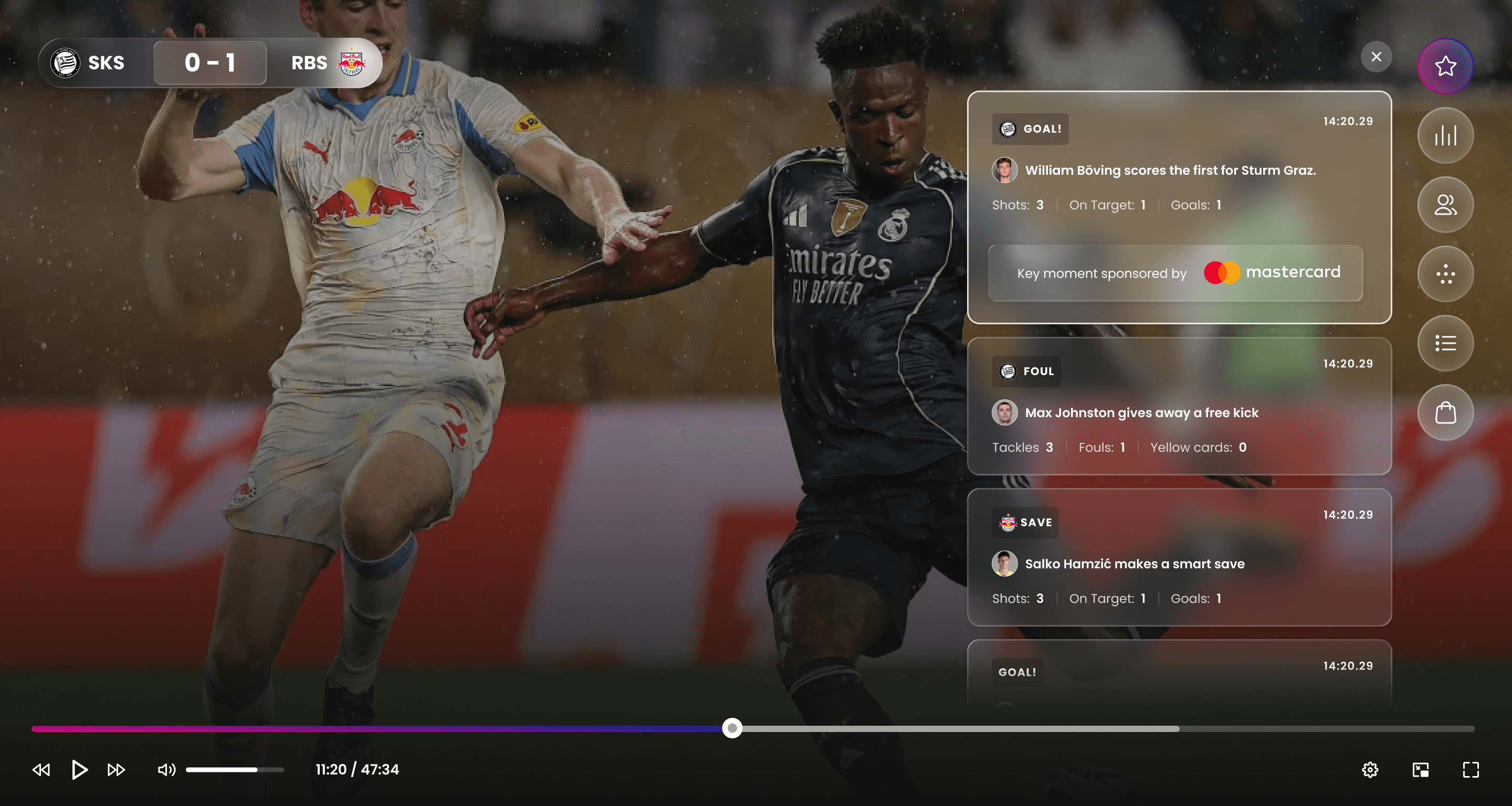
A live key moment can combine sporting context, relevant commerce and sponsor ownership within the viewing experience.
These experiences can be localised by territory and language, allowing different sponsors, products, messages and creative treatments to be presented within the same global event.
But greater flexibility creates a new set of questions.
Which premium moments were monetised, and which were missed? How much visibility did each sponsor receive? Were commercial placements presented too closely together? Did one brand dominate the experience? Was the balance between sponsorship, commerce and editorial content appropriate? What did fans in each market and language actually see?
These questions cannot be answered by activation technology alone. They require an analytics layer that understands the commercial experience in the same context in which it was created.
Turning sporting context into commercial relevance
Commercial messages are more likely to belong within a sports experience when they relate directly to what the fan is watching.
Instead of displaying the same offer at arbitrary intervals, Gameday can associate an activation with a specific event, player, team or level of importance. The product presented after a player scores can be connected to that player. A sponsor can own a particular class of key moment. Different event types can be assigned different commercial treatments.
This does not mean that every event should be monetised. It means that each activation can be deliberate.
Gameday’s automation engine evaluates live key-moment and play-by-play data, applies the relevant commercial rules and drives the resulting experience in real time. Its analytics suite then records how those rules were expressed in the front end.
The result is a complete view of the commercial activation, including:
The sporting moment that triggered it
The sponsor, product or promoted item attached to it
Whether it appeared on screen, in the timeline or across multiple surfaces
The territory and language in which it was presented
The timing and proximity of surrounding commercial placements
The importance assigned to the commercial opportunity
This creates an auditable connection between the sporting action, the commercial decision and the experience presented to the fan.
One key moment, multiple commercial surfaces
The same commercial activation can serve different purposes depending on how it is presented.
An on-screen placement captures the immediacy of a live moment. It can place a sponsor or relevant product directly alongside the action while fan attention is at its highest.
A timeline placement has a different role. It gives the activation persistence, allowing fans to revisit key moments and associated content after the immediate event has passed.
Gameday analyses these surfaces independently, giving product and commercial teams visibility into the overall placement mix.
A sponsorship campaign may prioritise prominent on-screen ownership. A commerce programme may benefit from longer-lived timeline placements. Some moments may justify both. Others may be better left entirely editorial.
Understanding this mix allows operators to optimise for commercial objectives without treating every placement as interchangeable.
Managing commercial density, not simply maximising volume
More activations do not automatically create more value.
If sponsorship messages, product offers and editorial cards are presented too frequently, the experience can quickly feel repetitive or intrusive. Closely grouped sponsor placements can also create competitive conflicts or reduce the prominence of each individual activation.
Gameday’s analytics suite makes commercial density visible.
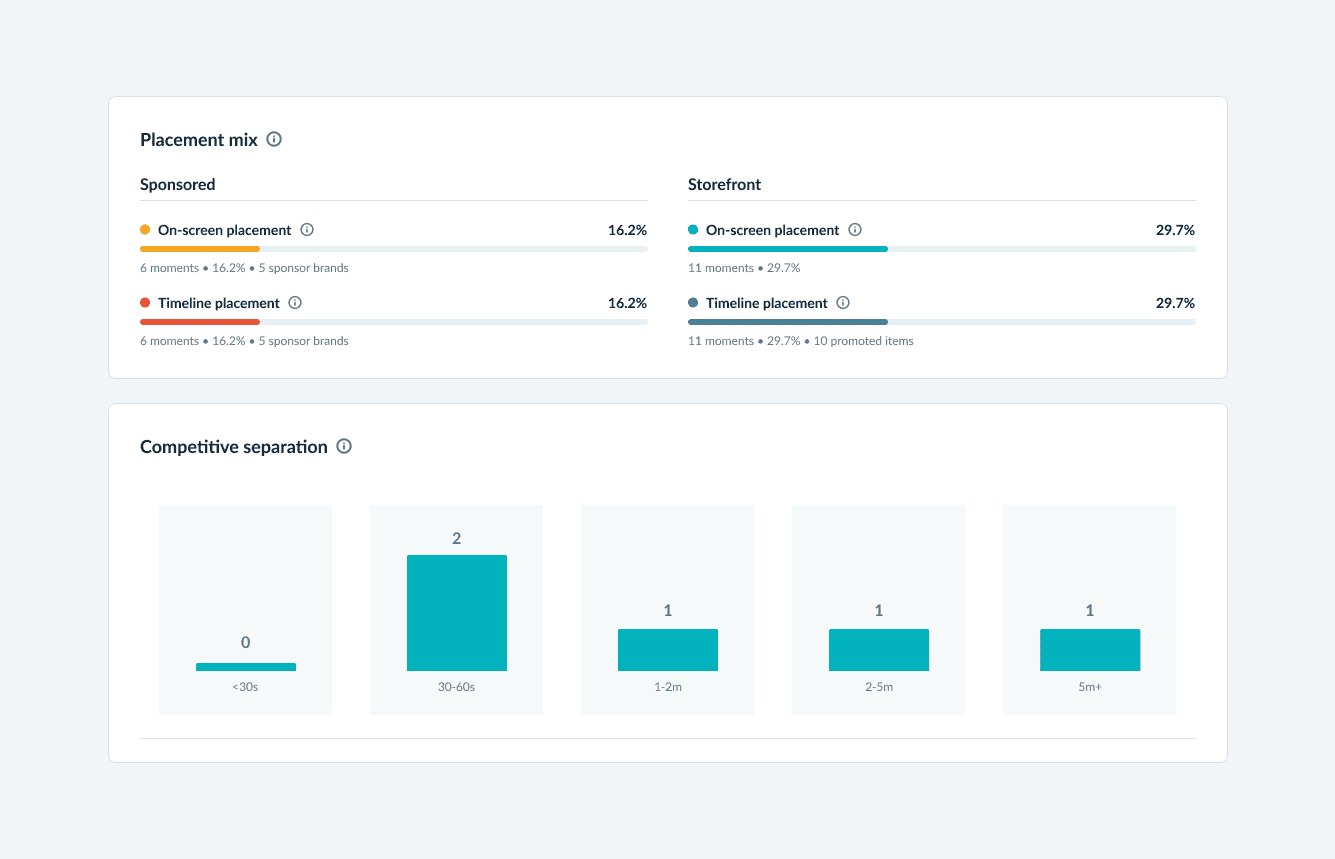
Placement-mix and separation analytics help teams manage commercial density rather than simply maximise activation volume.
Placement-mix reporting shows the balance between sponsored and storefront activations across on-screen and timeline formats. Competitive-separation analysis shows how closely different placements appeared to one another. Brand share-of-voice reporting reveals how commercial exposure was distributed.
These signals help teams assess whether the experience is balanced, whether campaign allocation is appropriate and whether activation rules need to be adjusted.
The objective is not maximum fill. It is the right blend of fan value, sponsor visibility and commercial opportunity.
Making localisation measurable
A global sporting event does not necessarily create one global commercial experience.
Sponsors can differ by market. Product availability can change by territory. Campaign copy may need to be translated or adapted. A product promoted to an English-language audience may have a different name, catalogue entry or commercial destination in Spanish or French.
Gameday already supports multi-region and multi-language data and content experiences. Its analytics suite extends that capability into commercial reporting.
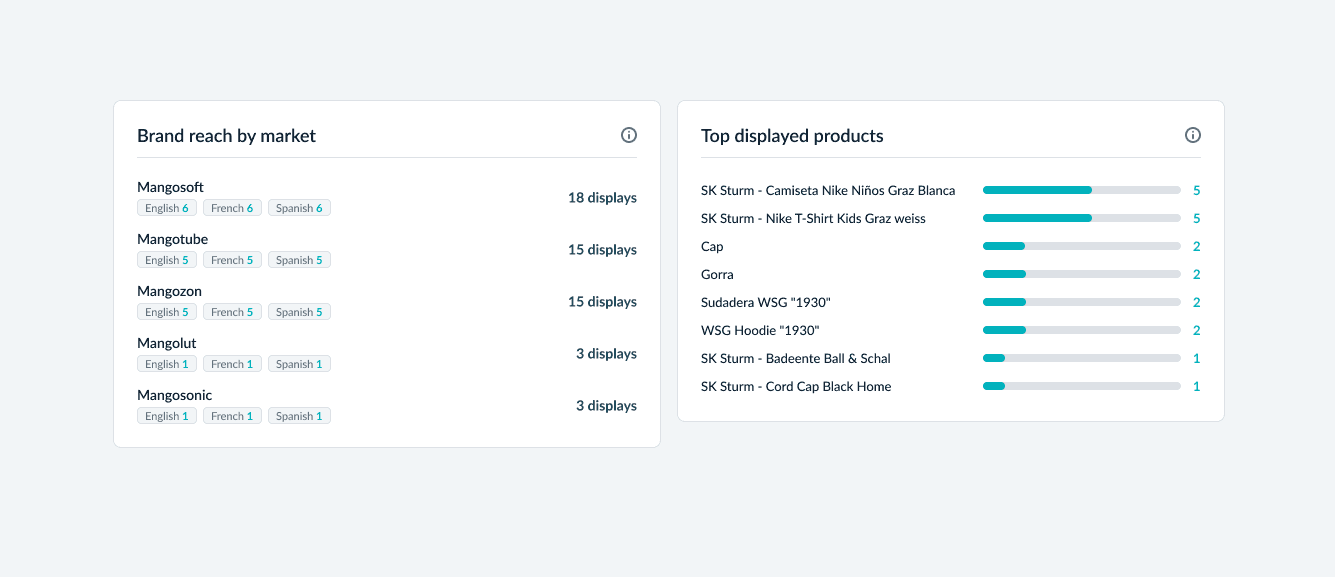
Gameday records the specific activations presented by event, surface, market and language.
Teams can inspect the activation timeline for an individual territory or language, review the specific products and sponsors presented, and compare delivery across markets.
This is particularly important for organisations managing regional rights, local sponsorship packages or multiple commerce catalogues. Rather than extrapolating from one global total, commercial teams can validate what was delivered in each market.
The same data can also reveal geographical or linguistic imbalances. A campaign may be performing as planned globally while remaining under-represented in a particular market. A product may be receiving significant exposure in one language but very little in another.
Localisation becomes something that can be governed and evaluated, rather than simply configured.
Identifying the opportunities that were missed
Some sporting moments carry greater commercial potential than others.
A decisive goal, major save or match-winning play may justify premium treatment. More routine events may be better suited to standard commerce, lighter sponsor presence or no activation at all.
Gameday can classify commercial moments by their relative importance and compare the available opportunity with what was actually monetised.
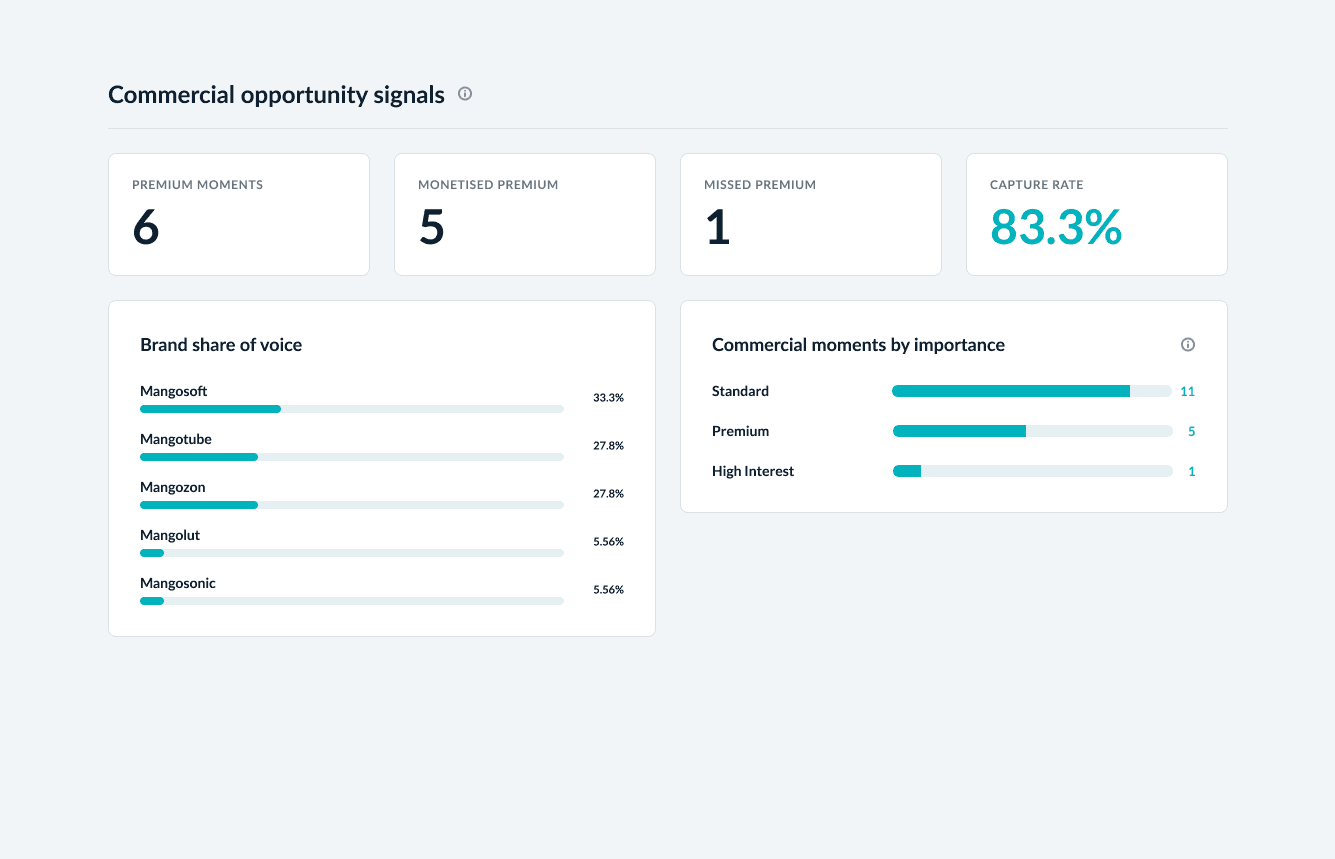
Commercial teams can compare premium opportunities with the moments actually monetised and identify unused potential.
Commercial opportunity signals show:
The number of premium moments within an event
How many of those moments were monetised
How many were missed
The resulting opportunity-capture rate
A missed premium moment is more than an unused placement. It is a signal that something within the commercial operation may need attention.
There may have been no eligible campaign. The relevant product could have been unavailable in that market. Activation rules may have been too restrictive. The moment may have exposed a gap in the current sponsorship or commerce proposition.
By making these gaps visible, Gameday turns missed inventory into actionable product and commercial intelligence.
Reporting by event type provides another level of insight. Teams can see whether goals, free kicks, corners, throw-ins or other play-by-play events are generating sponsored or storefront activations, and how those moments are distributed between standard, high-interest and premium classifications.
This allows operators to refine the role each sporting event plays within the wider commercial strategy.
Giving every team a common source of truth
Commercial activations involve more than the commercial department.
Sponsorship teams need evidence of campaign delivery and brand allocation. Commerce teams need to know which products were presented and in what context. Product teams need to understand how commercial content affected the composition of the experience. Editorial teams need visibility into how commercial and sporting narratives interact. Operations teams need to diagnose discrepancies between markets, languages and front-end surfaces.
Gameday gives these stakeholders a shared view of the same experience.
Brand share of voice shows how placements were allocated between commercial partners. Brand presentation by market and language provides a more detailed view of distribution. Product reporting identifies the items receiving the greatest exposure. Placement timelines provide an event-level record of what appeared and when.
Rather than reconciling separate campaign reports, commerce systems, editorial logs and front-end analytics, teams can work from a common commercial record grounded in the sporting event itself.
Closing the commercial optimisation loop
In many sports organisations, live data, campaign management, commerce, front-end presentation and analytics are spread across separate systems.
This fragmentation makes it difficult to connect a commercial result back to the moment, rule and presentation decision that created it.
Gameday connects those layers.
Live sports data informs the activation. The automation engine determines the appropriate experience. Gameday drives the front-end presentation. The analytics suite records how the activation was delivered. Teams can then use those insights to revise the rules, inventory and commercial mix.
It creates a continuous operating cycle:
Sporting moment → commercial decision → fan experience → delivery analytics → optimisation
Over time, operators can refine which moments deserve premium treatment, which surfaces are appropriate for each objective, how commercial messages should be paced and how inventory should vary between markets.
This is the difference between activating isolated pieces of inventory and operating an intelligent commercial experience.
Commercialisation that belongs in the fan experience
Fans should not experience sponsorship and commerce as unrelated interruptions around the sport.
Used carefully, commercial activations can add relevance to a key moment, connect fans with products they genuinely care about and give sponsors a more meaningful role within the experience.
Achieving that requires more than automation. It requires the ability to see and govern the complete commercial picture.
Gameday provides both.
It uses real-time sporting context to power dynamic, localised commercial experiences. It then provides the analytics needed to understand what was presented, assess how commercial opportunity was used and optimise the balance between fan engagement and revenue.
That closes the loop between the sporting moment and its commercial value.
Build a more measurable commercial layer into your sports experience
Discover how Gameday can help you automate, localise and analyse sponsorship and commerce activations across your live digital products.
Beyond activation: how Gameday turns commercial moments into actionable intelligence
Real-time sports data can trigger sponsorship and commerce at the moments fans care about most. Gameday’s commercial analytics suite provides the visibility needed to measure delivery, identify missed opportunities and optimise the commercial experience across every market and language.
The commercial challenge in live sport is no longer simply how to create more inventory. It is how to make that inventory relevant, controllable and measurable.
Traditional digital monetisation models tend to position commercial messages around the sport. Pre-roll, banners, fixed sponsor placements and generic shop links all have value, but they are often disconnected from what is happening in the event itself.
A modern sports experience has access to far richer context. It knows what just happened, which player or team was involved, how important the moment was, where the fan is located, which language they are using and which campaigns or products are available in that market.
Gameday uses this context to turn live sporting moments into configurable commercial opportunities.
A goal can trigger a sponsored key-moment card, present the scorer’s shirt and create a persistent entry in the match timeline. A save, corner, substitution or final whistle can activate a different experience based on the event, its commercial importance and the rules defined by the operator.
A live key moment can combine sporting context, relevant commerce and sponsor ownership within the viewing experience.
These experiences can be localised by territory and language, allowing different sponsors, products, messages and creative treatments to be presented within the same global event.
But greater flexibility creates a new set of questions.
Which premium moments were monetised, and which were missed? How much visibility did each sponsor receive? Were commercial placements presented too closely together? Did one brand dominate the experience? Was the balance between sponsorship, commerce and editorial content appropriate? What did fans in each market and language actually see?
These questions cannot be answered by activation technology alone. They require an analytics layer that understands the commercial experience in the same context in which it was created.
Turning sporting context into commercial relevance
Commercial messages are more likely to belong within a sports experience when they relate directly to what the fan is watching.
Instead of displaying the same offer at arbitrary intervals, Gameday can associate an activation with a specific event, player, team or level of importance. The product presented after a player scores can be connected to that player. A sponsor can own a particular class of key moment. Different event types can be assigned different commercial treatments.
This does not mean that every event should be monetised. It means that each activation can be deliberate.
Gameday’s automation engine evaluates live key-moment and play-by-play data, applies the relevant commercial rules and drives the resulting experience in real time. Its analytics suite then records how those rules were expressed in the front end.
The result is a complete view of the commercial activation, including:
The sporting moment that triggered it
The sponsor, product or promoted item attached to it
Whether it appeared on screen, in the timeline or across multiple surfaces
The territory and language in which it was presented
The timing and proximity of surrounding commercial placements
The importance assigned to the commercial opportunity
This creates an auditable connection between the sporting action, the commercial decision and the experience presented to the fan.
One key moment, multiple commercial surfaces
The same commercial activation can serve different purposes depending on how it is presented.
An on-screen placement captures the immediacy of a live moment. It can place a sponsor or relevant product directly alongside the action while fan attention is at its highest.
A timeline placement has a different role. It gives the activation persistence, allowing fans to revisit key moments and associated content after the immediate event has passed.
Gameday analyses these surfaces independently, giving product and commercial teams visibility into the overall placement mix.
A sponsorship campaign may prioritise prominent on-screen ownership. A commerce programme may benefit from longer-lived timeline placements. Some moments may justify both. Others may be better left entirely editorial.
Understanding this mix allows operators to optimise for commercial objectives without treating every placement as interchangeable.
Managing commercial density, not simply maximising volume
More activations do not automatically create more value.
If sponsorship messages, product offers and editorial cards are presented too frequently, the experience can quickly feel repetitive or intrusive. Closely grouped sponsor placements can also create competitive conflicts or reduce the prominence of each individual activation.
Gameday’s analytics suite makes commercial density visible.
Placement-mix and separation analytics help teams manage commercial density rather than simply maximise activation volume.
Placement-mix reporting shows the balance between sponsored and storefront activations across on-screen and timeline formats. Competitive-separation analysis shows how closely different placements appeared to one another. Brand share-of-voice reporting reveals how commercial exposure was distributed.
These signals help teams assess whether the experience is balanced, whether campaign allocation is appropriate and whether activation rules need to be adjusted.
The objective is not maximum fill. It is the right blend of fan value, sponsor visibility and commercial opportunity.
Making localisation measurable
A global sporting event does not necessarily create one global commercial experience.
Sponsors can differ by market. Product availability can change by territory. Campaign copy may need to be translated or adapted. A product promoted to an English-language audience may have a different name, catalogue entry or commercial destination in Spanish or French.
Gameday already supports multi-region and multi-language data and content experiences. Its analytics suite extends that capability into commercial reporting.
Gameday records the specific activations presented by event, surface, market and language.
Teams can inspect the activation timeline for an individual territory or language, review the specific products and sponsors presented, and compare delivery across markets.
This is particularly important for organisations managing regional rights, local sponsorship packages or multiple commerce catalogues. Rather than extrapolating from one global total, commercial teams can validate what was delivered in each market.
The same data can also reveal geographical or linguistic imbalances. A campaign may be performing as planned globally while remaining under-represented in a particular market. A product may be receiving significant exposure in one language but very little in another.
Localisation becomes something that can be governed and evaluated, rather than simply configured.
Identifying the opportunities that were missed
Some sporting moments carry greater commercial potential than others.
A decisive goal, major save or match-winning play may justify premium treatment. More routine events may be better suited to standard commerce, lighter sponsor presence or no activation at all.
Gameday can classify commercial moments by their relative importance and compare the available opportunity with what was actually monetised.
Commercial teams can compare premium opportunities with the moments actually monetised and identify unused potential.
Commercial opportunity signals show:
The number of premium moments within an event
How many of those moments were monetised
How many were missed
The resulting opportunity-capture rate
A missed premium moment is more than an unused placement. It is a signal that something within the commercial operation may need attention.
There may have been no eligible campaign. The relevant product could have been unavailable in that market. Activation rules may have been too restrictive. The moment may have exposed a gap in the current sponsorship or commerce proposition.
By making these gaps visible, Gameday turns missed inventory into actionable product and commercial intelligence.
Reporting by event type provides another level of insight. Teams can see whether goals, free kicks, corners, throw-ins or other play-by-play events are generating sponsored or storefront activations, and how those moments are distributed between standard, high-interest and premium classifications.
This allows operators to refine the role each sporting event plays within the wider commercial strategy.
Giving every team a common source of truth
Commercial activations involve more than the commercial department.
Sponsorship teams need evidence of campaign delivery and brand allocation. Commerce teams need to know which products were presented and in what context. Product teams need to understand how commercial content affected the composition of the experience. Editorial teams need visibility into how commercial and sporting narratives interact. Operations teams need to diagnose discrepancies between markets, languages and front-end surfaces.
Gameday gives these stakeholders a shared view of the same experience.
Brand share of voice shows how placements were allocated between commercial partners. Brand presentation by market and language provides a more detailed view of distribution. Product reporting identifies the items receiving the greatest exposure. Placement timelines provide an event-level record of what appeared and when.
Rather than reconciling separate campaign reports, commerce systems, editorial logs and front-end analytics, teams can work from a common commercial record grounded in the sporting event itself.
Closing the commercial optimisation loop
In many sports organisations, live data, campaign management, commerce, front-end presentation and analytics are spread across separate systems.
This fragmentation makes it difficult to connect a commercial result back to the moment, rule and presentation decision that created it.
Gameday connects those layers.
Live sports data informs the activation. The automation engine determines the appropriate experience. Gameday drives the front-end presentation. The analytics suite records how the activation was delivered. Teams can then use those insights to revise the rules, inventory and commercial mix.
It creates a continuous operating cycle:
Sporting moment → commercial decision → fan experience → delivery analytics → optimisation
Over time, operators can refine which moments deserve premium treatment, which surfaces are appropriate for each objective, how commercial messages should be paced and how inventory should vary between markets.
This is the difference between activating isolated pieces of inventory and operating an intelligent commercial experience.
Commercialisation that belongs in the fan experience
Fans should not experience sponsorship and commerce as unrelated interruptions around the sport.
Used carefully, commercial activations can add relevance to a key moment, connect fans with products they genuinely care about and give sponsors a more meaningful role within the experience.
Achieving that requires more than automation. It requires the ability to see and govern the complete commercial picture.
Gameday provides both.
It uses real-time sporting context to power dynamic, localised commercial experiences. It then provides the analytics needed to understand what was presented, assess how commercial opportunity was used and optimise the balance between fan engagement and revenue.
That closes the loop between the sporting moment and its commercial value.
Build a more measurable commercial layer into your sports experience
Discover how Gameday can help you automate, localise and analyse sponsorship and commerce activations across your live digital products.
Beyond activation: how Gameday turns commercial moments into actionable intelligence
Real-time sports data can trigger sponsorship and commerce at the moments fans care about most. Gameday’s commercial analytics suite provides the visibility needed to measure delivery, identify missed opportunities and optimise the commercial experience across every market and language.
The commercial challenge in live sport is no longer simply how to create more inventory. It is how to make that inventory relevant, controllable and measurable.
Traditional digital monetisation models tend to position commercial messages around the sport. Pre-roll, banners, fixed sponsor placements and generic shop links all have value, but they are often disconnected from what is happening in the event itself.
A modern sports experience has access to far richer context. It knows what just happened, which player or team was involved, how important the moment was, where the fan is located, which language they are using and which campaigns or products are available in that market.
Gameday uses this context to turn live sporting moments into configurable commercial opportunities.
A goal can trigger a sponsored key-moment card, present the scorer’s shirt and create a persistent entry in the match timeline. A save, corner, substitution or final whistle can activate a different experience based on the event, its commercial importance and the rules defined by the operator.
A live key moment can combine sporting context, relevant commerce and sponsor ownership within the viewing experience.
These experiences can be localised by territory and language, allowing different sponsors, products, messages and creative treatments to be presented within the same global event.
But greater flexibility creates a new set of questions.
Which premium moments were monetised, and which were missed? How much visibility did each sponsor receive? Were commercial placements presented too closely together? Did one brand dominate the experience? Was the balance between sponsorship, commerce and editorial content appropriate? What did fans in each market and language actually see?
These questions cannot be answered by activation technology alone. They require an analytics layer that understands the commercial experience in the same context in which it was created.
Turning sporting context into commercial relevance
Commercial messages are more likely to belong within a sports experience when they relate directly to what the fan is watching.
Instead of displaying the same offer at arbitrary intervals, Gameday can associate an activation with a specific event, player, team or level of importance. The product presented after a player scores can be connected to that player. A sponsor can own a particular class of key moment. Different event types can be assigned different commercial treatments.
This does not mean that every event should be monetised. It means that each activation can be deliberate.
Gameday’s automation engine evaluates live key-moment and play-by-play data, applies the relevant commercial rules and drives the resulting experience in real time. Its analytics suite then records how those rules were expressed in the front end.
The result is a complete view of the commercial activation, including:
The sporting moment that triggered it
The sponsor, product or promoted item attached to it
Whether it appeared on screen, in the timeline or across multiple surfaces
The territory and language in which it was presented
The timing and proximity of surrounding commercial placements
The importance assigned to the commercial opportunity
This creates an auditable connection between the sporting action, the commercial decision and the experience presented to the fan.
One key moment, multiple commercial surfaces
The same commercial activation can serve different purposes depending on how it is presented.
An on-screen placement captures the immediacy of a live moment. It can place a sponsor or relevant product directly alongside the action while fan attention is at its highest.
A timeline placement has a different role. It gives the activation persistence, allowing fans to revisit key moments and associated content after the immediate event has passed.
Gameday analyses these surfaces independently, giving product and commercial teams visibility into the overall placement mix.
A sponsorship campaign may prioritise prominent on-screen ownership. A commerce programme may benefit from longer-lived timeline placements. Some moments may justify both. Others may be better left entirely editorial.
Understanding this mix allows operators to optimise for commercial objectives without treating every placement as interchangeable.
Managing commercial density, not simply maximising volume
More activations do not automatically create more value.
If sponsorship messages, product offers and editorial cards are presented too frequently, the experience can quickly feel repetitive or intrusive. Closely grouped sponsor placements can also create competitive conflicts or reduce the prominence of each individual activation.
Gameday’s analytics suite makes commercial density visible.
Placement-mix and separation analytics help teams manage commercial density rather than simply maximise activation volume.
Placement-mix reporting shows the balance between sponsored and storefront activations across on-screen and timeline formats. Competitive-separation analysis shows how closely different placements appeared to one another. Brand share-of-voice reporting reveals how commercial exposure was distributed.
These signals help teams assess whether the experience is balanced, whether campaign allocation is appropriate and whether activation rules need to be adjusted.
The objective is not maximum fill. It is the right blend of fan value, sponsor visibility and commercial opportunity.
Making localisation measurable
A global sporting event does not necessarily create one global commercial experience.
Sponsors can differ by market. Product availability can change by territory. Campaign copy may need to be translated or adapted. A product promoted to an English-language audience may have a different name, catalogue entry or commercial destination in Spanish or French.
Gameday already supports multi-region and multi-language data and content experiences. Its analytics suite extends that capability into commercial reporting.
Gameday records the specific activations presented by event, surface, market and language.
Teams can inspect the activation timeline for an individual territory or language, review the specific products and sponsors presented, and compare delivery across markets.
This is particularly important for organisations managing regional rights, local sponsorship packages or multiple commerce catalogues. Rather than extrapolating from one global total, commercial teams can validate what was delivered in each market.
The same data can also reveal geographical or linguistic imbalances. A campaign may be performing as planned globally while remaining under-represented in a particular market. A product may be receiving significant exposure in one language but very little in another.
Localisation becomes something that can be governed and evaluated, rather than simply configured.
Identifying the opportunities that were missed
Some sporting moments carry greater commercial potential than others.
A decisive goal, major save or match-winning play may justify premium treatment. More routine events may be better suited to standard commerce, lighter sponsor presence or no activation at all.
Gameday can classify commercial moments by their relative importance and compare the available opportunity with what was actually monetised.
Commercial teams can compare premium opportunities with the moments actually monetised and identify unused potential.
Commercial opportunity signals show:
The number of premium moments within an event
How many of those moments were monetised
How many were missed
The resulting opportunity-capture rate
A missed premium moment is more than an unused placement. It is a signal that something within the commercial operation may need attention.
There may have been no eligible campaign. The relevant product could have been unavailable in that market. Activation rules may have been too restrictive. The moment may have exposed a gap in the current sponsorship or commerce proposition.
By making these gaps visible, Gameday turns missed inventory into actionable product and commercial intelligence.
Reporting by event type provides another level of insight. Teams can see whether goals, free kicks, corners, throw-ins or other play-by-play events are generating sponsored or storefront activations, and how those moments are distributed between standard, high-interest and premium classifications.
This allows operators to refine the role each sporting event plays within the wider commercial strategy.
Giving every team a common source of truth
Commercial activations involve more than the commercial department.
Sponsorship teams need evidence of campaign delivery and brand allocation. Commerce teams need to know which products were presented and in what context. Product teams need to understand how commercial content affected the composition of the experience. Editorial teams need visibility into how commercial and sporting narratives interact. Operations teams need to diagnose discrepancies between markets, languages and front-end surfaces.
Gameday gives these stakeholders a shared view of the same experience.
Brand share of voice shows how placements were allocated between commercial partners. Brand presentation by market and language provides a more detailed view of distribution. Product reporting identifies the items receiving the greatest exposure. Placement timelines provide an event-level record of what appeared and when.
Rather than reconciling separate campaign reports, commerce systems, editorial logs and front-end analytics, teams can work from a common commercial record grounded in the sporting event itself.
Closing the commercial optimisation loop
In many sports organisations, live data, campaign management, commerce, front-end presentation and analytics are spread across separate systems.
This fragmentation makes it difficult to connect a commercial result back to the moment, rule and presentation decision that created it.
Gameday connects those layers.
Live sports data informs the activation. The automation engine determines the appropriate experience. Gameday drives the front-end presentation. The analytics suite records how the activation was delivered. Teams can then use those insights to revise the rules, inventory and commercial mix.
It creates a continuous operating cycle:
Sporting moment → commercial decision → fan experience → delivery analytics → optimisation
Over time, operators can refine which moments deserve premium treatment, which surfaces are appropriate for each objective, how commercial messages should be paced and how inventory should vary between markets.
This is the difference between activating isolated pieces of inventory and operating an intelligent commercial experience.
Commercialisation that belongs in the fan experience
Fans should not experience sponsorship and commerce as unrelated interruptions around the sport.
Used carefully, commercial activations can add relevance to a key moment, connect fans with products they genuinely care about and give sponsors a more meaningful role within the experience.
Achieving that requires more than automation. It requires the ability to see and govern the complete commercial picture.
Gameday provides both.
It uses real-time sporting context to power dynamic, localised commercial experiences. It then provides the analytics needed to understand what was presented, assess how commercial opportunity was used and optimise the balance between fan engagement and revenue.
That closes the loop between the sporting moment and its commercial value.
Build a more measurable commercial layer into your sports experience
Discover how Gameday can help you automate, localise and analyse sponsorship and commerce activations across your live digital products.
Beyond activation: how Gameday turns commercial moments into actionable intelligence
Real-time sports data can trigger sponsorship and commerce at the moments fans care about most. Gameday’s commercial analytics suite provides the visibility needed to measure delivery, identify missed opportunities and optimise the commercial experience across every market and language.
The commercial challenge in live sport is no longer simply how to create more inventory. It is how to make that inventory relevant, controllable and measurable.
Traditional digital monetisation models tend to position commercial messages around the sport. Pre-roll, banners, fixed sponsor placements and generic shop links all have value, but they are often disconnected from what is happening in the event itself.
A modern sports experience has access to far richer context. It knows what just happened, which player or team was involved, how important the moment was, where the fan is located, which language they are using and which campaigns or products are available in that market.
Gameday uses this context to turn live sporting moments into configurable commercial opportunities.
A goal can trigger a sponsored key-moment card, present the scorer’s shirt and create a persistent entry in the match timeline. A save, corner, substitution or final whistle can activate a different experience based on the event, its commercial importance and the rules defined by the operator.
A live key moment can combine sporting context, relevant commerce and sponsor ownership within the viewing experience.
These experiences can be localised by territory and language, allowing different sponsors, products, messages and creative treatments to be presented within the same global event.
But greater flexibility creates a new set of questions.
Which premium moments were monetised, and which were missed? How much visibility did each sponsor receive? Were commercial placements presented too closely together? Did one brand dominate the experience? Was the balance between sponsorship, commerce and editorial content appropriate? What did fans in each market and language actually see?
These questions cannot be answered by activation technology alone. They require an analytics layer that understands the commercial experience in the same context in which it was created.
Turning sporting context into commercial relevance
Commercial messages are more likely to belong within a sports experience when they relate directly to what the fan is watching.
Instead of displaying the same offer at arbitrary intervals, Gameday can associate an activation with a specific event, player, team or level of importance. The product presented after a player scores can be connected to that player. A sponsor can own a particular class of key moment. Different event types can be assigned different commercial treatments.
This does not mean that every event should be monetised. It means that each activation can be deliberate.
Gameday’s automation engine evaluates live key-moment and play-by-play data, applies the relevant commercial rules and drives the resulting experience in real time. Its analytics suite then records how those rules were expressed in the front end.
The result is a complete view of the commercial activation, including:
The sporting moment that triggered it
The sponsor, product or promoted item attached to it
Whether it appeared on screen, in the timeline or across multiple surfaces
The territory and language in which it was presented
The timing and proximity of surrounding commercial placements
The importance assigned to the commercial opportunity
This creates an auditable connection between the sporting action, the commercial decision and the experience presented to the fan.
One key moment, multiple commercial surfaces
The same commercial activation can serve different purposes depending on how it is presented.
An on-screen placement captures the immediacy of a live moment. It can place a sponsor or relevant product directly alongside the action while fan attention is at its highest.
A timeline placement has a different role. It gives the activation persistence, allowing fans to revisit key moments and associated content after the immediate event has passed.
Gameday analyses these surfaces independently, giving product and commercial teams visibility into the overall placement mix.
A sponsorship campaign may prioritise prominent on-screen ownership. A commerce programme may benefit from longer-lived timeline placements. Some moments may justify both. Others may be better left entirely editorial.
Understanding this mix allows operators to optimise for commercial objectives without treating every placement as interchangeable.
Managing commercial density, not simply maximising volume
More activations do not automatically create more value.
If sponsorship messages, product offers and editorial cards are presented too frequently, the experience can quickly feel repetitive or intrusive. Closely grouped sponsor placements can also create competitive conflicts or reduce the prominence of each individual activation.
Gameday’s analytics suite makes commercial density visible.
Placement-mix and separation analytics help teams manage commercial density rather than simply maximise activation volume.
Placement-mix reporting shows the balance between sponsored and storefront activations across on-screen and timeline formats. Competitive-separation analysis shows how closely different placements appeared to one another. Brand share-of-voice reporting reveals how commercial exposure was distributed.
These signals help teams assess whether the experience is balanced, whether campaign allocation is appropriate and whether activation rules need to be adjusted.
The objective is not maximum fill. It is the right blend of fan value, sponsor visibility and commercial opportunity.
Making localisation measurable
A global sporting event does not necessarily create one global commercial experience.
Sponsors can differ by market. Product availability can change by territory. Campaign copy may need to be translated or adapted. A product promoted to an English-language audience may have a different name, catalogue entry or commercial destination in Spanish or French.
Gameday already supports multi-region and multi-language data and content experiences. Its analytics suite extends that capability into commercial reporting.
Gameday records the specific activations presented by event, surface, market and language.
Teams can inspect the activation timeline for an individual territory or language, review the specific products and sponsors presented, and compare delivery across markets.
This is particularly important for organisations managing regional rights, local sponsorship packages or multiple commerce catalogues. Rather than extrapolating from one global total, commercial teams can validate what was delivered in each market.
The same data can also reveal geographical or linguistic imbalances. A campaign may be performing as planned globally while remaining under-represented in a particular market. A product may be receiving significant exposure in one language but very little in another.
Localisation becomes something that can be governed and evaluated, rather than simply configured.
Identifying the opportunities that were missed
Some sporting moments carry greater commercial potential than others.
A decisive goal, major save or match-winning play may justify premium treatment. More routine events may be better suited to standard commerce, lighter sponsor presence or no activation at all.
Gameday can classify commercial moments by their relative importance and compare the available opportunity with what was actually monetised.
Commercial teams can compare premium opportunities with the moments actually monetised and identify unused potential.
Commercial opportunity signals show:
The number of premium moments within an event
How many of those moments were monetised
How many were missed
The resulting opportunity-capture rate
A missed premium moment is more than an unused placement. It is a signal that something within the commercial operation may need attention.
There may have been no eligible campaign. The relevant product could have been unavailable in that market. Activation rules may have been too restrictive. The moment may have exposed a gap in the current sponsorship or commerce proposition.
By making these gaps visible, Gameday turns missed inventory into actionable product and commercial intelligence.
Reporting by event type provides another level of insight. Teams can see whether goals, free kicks, corners, throw-ins or other play-by-play events are generating sponsored or storefront activations, and how those moments are distributed between standard, high-interest and premium classifications.
This allows operators to refine the role each sporting event plays within the wider commercial strategy.
Giving every team a common source of truth
Commercial activations involve more than the commercial department.
Sponsorship teams need evidence of campaign delivery and brand allocation. Commerce teams need to know which products were presented and in what context. Product teams need to understand how commercial content affected the composition of the experience. Editorial teams need visibility into how commercial and sporting narratives interact. Operations teams need to diagnose discrepancies between markets, languages and front-end surfaces.
Gameday gives these stakeholders a shared view of the same experience.
Brand share of voice shows how placements were allocated between commercial partners. Brand presentation by market and language provides a more detailed view of distribution. Product reporting identifies the items receiving the greatest exposure. Placement timelines provide an event-level record of what appeared and when.
Rather than reconciling separate campaign reports, commerce systems, editorial logs and front-end analytics, teams can work from a common commercial record grounded in the sporting event itself.
Closing the commercial optimisation loop
In many sports organisations, live data, campaign management, commerce, front-end presentation and analytics are spread across separate systems.
This fragmentation makes it difficult to connect a commercial result back to the moment, rule and presentation decision that created it.
Gameday connects those layers.
Live sports data informs the activation. The automation engine determines the appropriate experience. Gameday drives the front-end presentation. The analytics suite records how the activation was delivered. Teams can then use those insights to revise the rules, inventory and commercial mix.
It creates a continuous operating cycle:
Sporting moment → commercial decision → fan experience → delivery analytics → optimisation
Over time, operators can refine which moments deserve premium treatment, which surfaces are appropriate for each objective, how commercial messages should be paced and how inventory should vary between markets.
This is the difference between activating isolated pieces of inventory and operating an intelligent commercial experience.
Commercialisation that belongs in the fan experience
Fans should not experience sponsorship and commerce as unrelated interruptions around the sport.
Used carefully, commercial activations can add relevance to a key moment, connect fans with products they genuinely care about and give sponsors a more meaningful role within the experience.
Achieving that requires more than automation. It requires the ability to see and govern the complete commercial picture.
Gameday provides both.
It uses real-time sporting context to power dynamic, localised commercial experiences. It then provides the analytics needed to understand what was presented, assess how commercial opportunity was used and optimise the balance between fan engagement and revenue.
That closes the loop between the sporting moment and its commercial value.
Build a more measurable commercial layer into your sports experience
Discover how Gameday can help you automate, localise and analyse sponsorship and commerce activations across your live digital products.
To find out more about anything you've read here, or to learn how Spicy Mango could help, drop us a note at hello@spicymango.co.uk, give us a call, or send us a message using our contact form and we'll be in touch.
To find out more about anything you've read here, or to learn how Spicy Mango could help, drop us a note at hello@spicymango.co.uk, give us a call, or send us a message using our contact form and we'll be in touch.
To find out more about anything you've read here, or to learn how Spicy Mango could help, drop us a note at hello@spicymango.co.uk, give us a call, or send us a message using our contact form and we'll be in touch.